Posted by Mark A. Rayner
on December 21, 2009
Hinky History,
The Lost PowerPoints /
3 Comments
Thag presents “Less darky!” (circa 11,564 BC) –> Only slide
- Shortest day in year
- Less darky after this
- More light good
- Pass mammoth rib please!
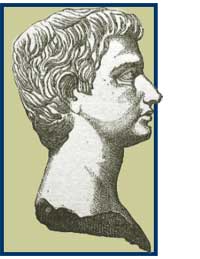
Catullus presents “Saturnalia ho!” (circa 69 BC) –> Slide 6
- gifts
- gambling
- tomfoolery (masters serve the slaves, nudge, nudge)
- public nudity
- the best of times!
Snagur Snarfasson presents “Yule be guessing” (circa 215 AD) –> Slide 3
Julebukking is the best:
- Disguise ourselves in masks and costumes
- Carry dead goat’s head in honor of Thor
- Visit neighbors
- Scare shit out of them ’till they give us mead.
Origen presents “Nativity schmativity” (circa 245 AD) –> Slide 1
- Christ is not like some pharaoh
- Only sinners celebrate birthdays
- Do you want to be a sinner?
King Richard II presents “Pig out with the Plantagentents!” (circa 1377 AD) –> slide 12
Christmas feast includes:
- 28 oxen
- 300 sheep
- 2000 chickens
- 1 Yule boar.
Thomas Nast presents “Fat Santa” (circa 1863) –> slide 3
- Harper’s wants a Santa Claus illustration
- Everyone else draws him like some emaciated string bean
- I’m going to make him a fat jolly bastard.
Beautiful photo by Peter Bowers. He has nothing to do (that we know of) with humor-blogs.com or Alltop. Originally published December 2007.
Tags: Christmas, fat bastard, feast, Jule, Saturnalia, Winter festival, winter solstice, Yule
Posted by Mark A. Rayner
on December 11, 2009
The Lost PowerPoints /
No Comments
Leo X Rejoices (circa March 11, 1513) –> slide 2
- It has served us well, this myth of Christ.
- God has given us the papacy
- Let us enjoy it
- That means party like it’s 1599!
Secretary intimus of Leo X presents a short list of things required for next Papal parade (circa 1514)
–> slide 5
- 24 tuns of wine
- 12 panthers
- 3 jesters
- plus, Hanno, the white elephant.
Alfonso Petrucci presents “The Pope must die” (circa 1517) –> slide 6
- Spends too much money on himself
- Always drunk
- This “St. Peter’s Basilica” project is also very expensive
- Not to mention the 6,000 ducats he gave in alms last year.
Leo X presents “What to do with a problem like Petrucci?” –> slide 2
- Follow his co-conspirators
- Wouldn’t it be terrible if they all caught fatal “food poisoning”?
- Oh, and let’s strangle Alfonso.
Leo X presents Bull! (circa 1520) –> slide 1
- Exsurge Domine
- Luther must retract 41 of 95 theses
- Or be excommunicated
- (Christians must be taught to cherish excommunications rather than to fear them.)
Leo X presents “It’s good to be Pope” (circa 1521) –> slide 7
- So what if Luther burned my Bull?
- We’ll burn heretics like him.
- Can someone do something about all these mosquitoes?
Alltop and humor-blogs.com like funny hats too. Pope Leo X, b. December 11, 1475, d. December 1, 1521 (of malaria). x Originally published, Dec. 2006.
Tags: bull, Catholic Church, counter-reformation, Exsurge Domine, heretics, Pope Leo X, powerpoint slides, reformation
Posted by Mark A. Rayner
on November 11, 2009
Hinky History,
The Lost PowerPoints /
1 Comment
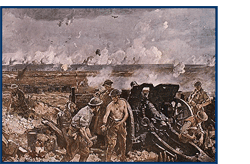
General Ludwig von Falkenhausen presents “The Week of Suffering” (circa April 2-9, 1917) –>slide 2
- Artillery relentless
- I’d guess about a million shells
- Somehow can target our artillery, even though they’re hidden behind ridge
- We ran out of aspirin, earplugs.
Allied General Arthur Currie presents “Better Creeping” (circa April 9, 1917) –>slide 4
- first wave attacks behind creeping barrage
- continuous line of shells
- improve on what we did at the Somme.
Corporal Gus Sivertz (2nd Canadian Mounted Rifles) presents “Nervy” –>slide 7
- a macabre dance
- nerves vibrated
- thousands of shells, machine gun bullets whizzed overhead
- advanced over no-man’s land
- if you put your hand up, you’d touch a ceiling of sound
- and probably lose a finger or two.
French soldier learns of victory at Vimy –>slide 1
French soldier learns four Canadian divisions fighting at Vimy with one British division–>slide 2
- Ah! les Canadiens! C’est possible!
Notes: The shelling at the battle began April 2, 1917, and the battle itself began on April 9, 1917. Vimy marked the first time that Canadian troops fought together on a a corps level, and they took the ridge with casualties of 10,000. Previous attempts to break the strong-point in the German line had cost French and British troops more than 150,000. Vimy is often seen as a defining moment in Canadian national history, and as Pierre Burton wrote in his book on the battle, it quickly attained mythic status. This seems like an appropriate post for Remembrance Day.

Posted by Mark A. Rayner
on November 09, 2009
But is it art?,
The Lost PowerPoints /
No Comments
Presentation of Oeuvre (slides one through five)

A Princess of Mars (first book in John Carter of Mars series)
- Disaffected ne’er-do-well white man rescues savage and extremely naked princess
- Along the way, he learns her language, fights strange creatures, and proves his superiority
- Then he gets it on with her.
Tarzan of the Apes (first book in Tarzan series)
- White child raised by apes becomes a noble and mostly naked savage
- He meets Jane, a beautiful English woman, and must save her
- Along the way he learns her language, fights dangerous creatures and proves his superiority
- Get back to England. He gets it on with her.
At the Earth’s Core (first book in Pellucidar series)
- Idealistic white hero David Innes must rescue savage and sexy Dian from flying dinosaur-like hominds
- Along the way, he learns her language, fights strange creatures, and proves his superiority
- Then they get it on.
Pirates of Venus (first book in Venus Series series)
- Idiotic white hero tries to fly to Mars and ends up in Venus
- He falls in love with Venusian princess (who is in her voluptuous way a barbarian)
- Along the way, he learns her language, fights strange creatures, and proves his superiority
- Then she blows his mind, that tart.
Etc.
Alltop and humor-blogs.com are the ugly savages that ERB’s hero is about to kick the crap out of. In honor of ERB: I read most of his books when I was a kid, until I figured out it was the same story over and over again. Little did I know that is the secret to success in the literary world. Artwork based on photo by lechatmachine. Originally published in September, 2005. Seriously.
Tags: edgar rice burroughs, formulaic plots, john carter of mars, pellucidar, tarzan
Victor Frankenstein Presents Whack-Job Theory (slide 1)
- Take dead body parts and stitch together
- Stick electrodes in
- Charge with massive jolt of lightning
- Of course it’s obscene, I’m Victor Frankenstein!
Victor Frankenstein Presents “What was I thinking?” (slide 6)
- Man, I must be nuts, but then again, I am Victor Frankenstein
- Creature was brutal to look at
- Plus, it just killed my brother
- Oh, now it’s killed my best friend
- And my newlywed wife.
The Monster Presents the Concept of “Fire” (only slide)
The Monster Explains Itself to Frankenstein(slide 2)
- Actually, old boy, you really made me feel quite unwanted
- Remember when you animated me, and I smiled at you, and you ran screaming from the lab in horror?
- Yes, that was when I decided to ruin your life.
- When did I learn to speak? Oh, between murdering your brother and your best friend I went to college. (I majored in communications.)
Humor-blogs.com and Alltop are also grotesque monstrosities that you should fear. Thanks to bbaltimore for the photo.
Tags: Frankenstein, Frankenstein's monster, Halloween
Posted by Mark A. Rayner
on July 04, 2008
The Lost PowerPoints /
2 Comments
John Hancock proposes boycott of British East India Company tea to Colonial housewives, 1769 (slide 4)

- I agree tea is lovely but coffee is good too
- Because, this will hurt British
- Yes, my signature is big
- No, not indicative of anything else, Madame.
Paul Revere delivers Suffolk Resolves to First Continental Congress, 1774 (final slide)
To recap:
- no British goods
- raise militia
- ignore British rule
- Intolerable Acts — really intolerable.
Thomas Paine presents Common Sense in Philadelphia, 1776 (slide 3)
Being part of Britain — third problem:
- drag America into unnecessary wars.
Jefferson previews first draft of Declaration of Independence to other committee members, 1776 (slide 4)
Unalienable rights — further explanation:
- not being killed or life?
- freedom from slavery or liberty?
- pursuit of happiness or — swag, property, bling?
- open to suggestions…
Jacques-Donatien Le Ray invites Benjamin Franklin to stay at his fully staffed mansion in Paris, 1776 (slide 12)
- As I love liberty, and believe all men are equal
- Use my mansion in Passy
- No electricity experiments is all I ask
- France and America will always be great friends!
Baron von Steuben drills Continental Army at Valley Forge, 1778 (slide 12)
Key elements of Prussian order:
- bad food
- harsh conditions
- severe discipline
- “friendship” of your fellow soldier.
Washington farewell address, 1796 (slide 7)
Further, regarding sectionalism:
- not so sure a two-party state is a good idea.
Happy holiday to everyone in the States, including all the busy bloggers at humor-blogs.com and alltop. Thanks to d4rr3ll for the fireworks photo.
Posted by Mark A. Rayner
on June 26, 2008
The Lost PowerPoints /
5 Comments
The Battle of Waterloo
Napoleon Bonaparte is an iconic character, not only because he was short, wore a silly hat, and had enough pirate brothers to conquer most of Europe, but because he is the only person in history to meet his Waterloo actually at Waterloo. (The rest of us tend to meet it in boardrooms, law courts, amateur beard-growing competitions, and if you’re English, in Surrey.) Had Napoleon won the Battle of Waterloo, civilization would be quite different. For starters, there wouldn’t be 2,050,000 results on Google for the term “French surrender” (there would only be 2,049,999.) Also, we would all eat a lot more snails.
But Napoleon did not win the battle. Later his opponent, the Duke of Wellington (also famed for rendering beef completely inedible and known as “Sally” to his friends), described the fighting as: “The nearest run thing you ever saw in your life,” which was Sally’s way of saying Napoleon almost won. To add insult to injury, Napoleon’s famed Imperial Guard — the closest thing the French Army had to crack assault pirates — ran away:

My pirate brothers and sisters include Captain Stanky and Rank Ol’ Pete.
Tags: humor, Lost PowerPoint Slides, Monkey Kin, napoleon, napoleon surrenders, satire
Posted by Mark A. Rayner
on June 16, 2008
The Lost PowerPoints /
3 Comments
The Victorians
Charles Darwin and the Theory of Evolution
Unlike today, the Theory of Evolution was not accepted by all members of society, not even in the United Kingdom, where Charles Darwin pioneered his important scientific discoveries; while Darwin explored the marketing possibilities of ape-powered robots, other men like Thomas Huxley were left to convince the rest of the scientific community of Evolution’s validity. This debate came to a head when during a widely publicized discussion before the British Association for the Advancement of Science, one of the major opponents of Evolution, the Lord Bishop of Oxford Samuel Wilberforce, asked Huxley if it was his mother or father who was an ape.

Communism
The ideology of communism has its roots in the Victorian Era, when Karl Marx and his pirate brother, Friedrich Engels, wrote the Communist Manifesto, which was all about overthrowing capitalism, sharing the means of production and scoring chicks.

This site and this one are all about scoring laughs.
Posted by Mark A. Rayner
on June 09, 2008
Hinky History,
The Lost PowerPoints /
No Comments
Queen Elizabeth I
In her day, the first Queen Elizabeth (Queen Elizabeth I), was widely regarded as the scariest female to roam the planet since Lucy the Menopausal T-Rex. Of course, her closest advisers and the members of the English court knew that was far from the truth: Elizabeth would have destroyed Lucy.
However, amongst her subjects, she was known as Good Queen Bess; she was known as the Virgin Queen, and much beloved because she really did care about her people. The whole question of virginity was a potential PR nightmare, though in the long run, not as destructive as the lead-based makeup Bess spackled onto her face for public functions.

The Spanish Armada
In 1588 the King of Spain (Phillip II) finally got fed up with English privateers continually raiding his ships and colonies in the New World. (Note: Privateers were a kind of state-sanctioned pirate. Though they were obligated to give a portion of their booty to the monarch who licensed their pillaging, they still had hooks for hands, parrots for pets, and spent a great deal of time obsessing over “pieces of eight.”)
To put an end to English interference, Phillip amassed a ginormous flotilla — the didn’t call it an “Armada” for nothing — to support his invasion of England. The Spanish fleet might have sailed in 1587, had not the English hero, Sir Francis Drake, staged a preemptive raid on Cadiz.

For an armada of humor, set sail for the Isle of Laughter or the Archipelago of Chuckles. More Lost PowerPoint Slides can be found here.