 |
Emily's Biography | The Oeuvre | Flannigan Bio | The Inventions |  |
| Associated Figures | Literary Contest | The Frolics Store | About the Circle |
|
|
|||||||||||
Associated Figures |
||||||||||||
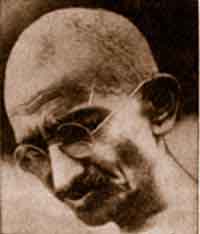
| ...Mahatma Gandhi | |||||
 |
|||||
|
|
The Gandhi Connection It was during her travels and torrid romance with the stallion-like Karl de Wittgen that Emily was introduced to a remarkable young Indian by the name of Mohandas Karamchand Gandhi, or Mohatma to his friends. After completing his legal studies in London, the 24-year-old had steamed to South Africa in 1893 to fulfill a one-year contract working on a civil suit involving a trade rivalry and family feud between two of the biggest Indian merchants in South Africa, Abdulla of Natal and Tyeb Sheth of Transvaal. After bringing the suit to a happy conclusion, Gandhi delayed his return home to India in favour of waging battle against a bill being introduced in the Natal legislature to disfranchise Indian settlers. For the next 20 years, he would be a driving force in the Indian community's fight for civil rights. It was also during these years that he developed the principle of 'satayagraha' - non-violent civil disobedience - whch he held fast to in spite of persecution and imprisonment. In 1899, as the Boer War broke out, Gandhi was faced with a major decision on the position the Indian community should adopt towards the conflict that was to change, for better or for worse, the history of South Africa. It was precisely at this time that he met Emily Chesley. They met to discuss a civil suit he was representing on behalf of Mabel Tolkien against Emily's uncle, Michael Flannigan. The suit sought damages in the death of Mabel's husband, Arthur, who bled to death after using an early prototype of Flannigan's Single Action Facial Hair Removal Device. Emily was acting on her uncle's behalf. After their meeting, Ghandi inexplicably decided to drop the suit against Emily's uncle, despite the fact it would condemn his client to a life of destitution. It was at the same time that Gandhi made his decision to side with the British instead of the Boers in the ensuing war. Some historians argue that the motivation behind this decision was jealousy - to spite the Boer Karl de Wittgen and his possession of Emily's passions. Those arguments are based on the recollections of Mukergee Mehta Vulpha, an Indian who had traveled from Calcutta to Durban to counsel the young lawyer on ancient relaxation techniques. In his book, Get Yer Ya Yas Out: The Soothing Wisdom of the Kama Sutra, Vulpha wrote:
"Mohatma told me he met a mysterious white women on whom he had practiced, for the first time, a few of the new techniques he was just learning. He performed them feebly, but said the woman had been very, very good to him nonetheless. In return for her compassion, he told her she should look him up sometime if she was ever in his neck of the woods. At such a time, he hoped he would be more skilled in the Kama Sutra so that he could return with more confidence, stamina and dexterity the many favours she had bestowed upon him." --"Scholarship" by Foothills
|
|
|||
|
|
Emily's
Bio | The
Oeuvre | Flannigan
Bio | Inventions
Join our mailing list or send us email. All written material, graphics, logo, and html coding Web Monkey : Mark A. Rayner
|
 |
|||