 |
Emily's Biography | The Oeuvre | Flannigan Bio | The Inventions |  |
| Associated Figures | Literary Contest | The Frolics Store | About the Circle |
|
|
|||||||||||
Associated Figures |
||||||||||||
| The Friar’s Tarts | |||
 |
|||
|
|
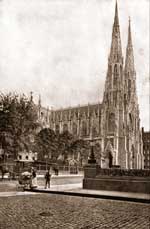
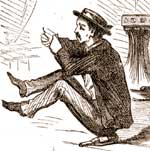
The effect that Emily Chesley’s wayward aunts, Mary, Hope and Chelsea, had on her life is well-documented in the early chapters of the speculative songstress’s biography. But until recently, little was known of what happened to the sisters after they split from Emily, her mother and her “uncle”, Michael Flannigan, after their arrival in New York City, circa. 1863. When they landed in America, Michael Flannigan was flat broke. With their brother unable to support the majestic sweep of their predilections, the three sisters opted to stay in the burgeoning metropolis of New York, and return to an earlier – indeed, the oldest – lifestyle. Except for their entries in the Castle Garden immigration records, none of the sisters appear in the historical record from 1863 through the late 1880s. They probably eked out a living as they used to in London, and no doubt the accommodations were even worse though the food may have been better, having had some of the English removed from it. The Flannigan sisters burst onto the scene again in 1889, when a new brothel was opened on the outskirts of the Manhattan tenements, very near to St. Patrick’s Cathedral (this had been completed ten years before). This was brilliant bit of locationism, (1) given that the sisters had decided to call their new brothel, The Friary. No doubt they chose this name not only because of their proximity to the cathedral, but because of their fond memories of the friary in Ennis, where they were well-known by all the monks (except for the fey boy known as “Brother Floopsie”) as "The Friar's Tarts". Chelsea was the madame of the Friary. This was because of her “infirmity”, the result of an extraordinarily well-hung fence wedgie given to her by Emily Chesley’s mother, Molly, during one of her many psychotic episodes. In practice, all three sisters would take turns running the establishment on a monthly rotation, while the other two spent the profits in a variety of expensive, lewd and quasi-legal pursuits, but most historians acknowledge that Chelsea was the mastermind of the Friary. (2) Chelsea’s “infirmity” denied her certain “below-the-waist” activities, which had the unfortunate effect of giving her lots of time to think. Her first scheme was to pay police officers to bring wealthy drunkards to The Friary “tank”, where the malefactors were charged for “services rendered”, even if all they did was sleep off an evening of too much crusty port. Hope shared some of the creative instincts of her brother and niece, and took to the new art of photography, an extremely expensive hobby. Mary, a consummate slattern, attempted to seduce many of New York’s most important men. Chelsea, seeing another business opportunity in her sisters' passions, combined the two, and had a lucrative sideline in what she called “marriage insurance.” And while happy with the success of the “tank” Chelsea felt that they could serve many more customers than the handful the cops could arrest every evening. She achieve this by hiring a number of Cornish ruffians to cosh unsuspecting (and wealthy) revelers, and have them delivered via handcart, and when available, NYPD wagons. Uncharacteristically, it was Hope who suggested she photograph these unfortunates with her sister Mary, and charge them for “marriage insurance” as well as for “services rendered.” Gentleman who found themselves the victims of the Friar’s Tarts, as they became known, tried to laugh off their troubles, and formed an impromptu “Friar’s Club.” (3) It was about this time that the public began to complain about rampant prostitution, alcohol abuse and police corruption. In 1895, New York turned to Theodore Roosevelt to clean up the city as its new police commissioner. An iron-willed leader of unimpeachable honesty, Roosevelt brought a reforming zeal to the New York City Police Commission. The sisters wisely curtailed the two main sources of The Friary’s income, the drunk tank and their marriage insurance scheme. This left them with somewhat depleted resources that could only be overcome by some honest, old-fashioned whoring. (4) The sisters hired a number of new women to flesh out their roster, so to speak, and advertised as widely as possible. Many of Chelsea’s best friends in the police force joined Roosevelt’s new bike squad, which was created to help sort out the city’s growing traffic problems. They also served as excellent messengers, and Cheslea traded the services of Mary and Hope in exchange for the bike-cops delivering hand-bills throughout the city. (5) Both Hope and Mary expressed a fondness for the “mighty thews” of these “barrel-chested guardians of justice” and the bike cops became regular features at the Friary. Things turned ugly for the Tarts when they found themselves caught between warring crime factions in early 1900. On one side were the Irish gangs (with the occasionally bit of help from the NYPD) and on the other were an outfit known as the Viking Wheelmen. Led by Thudgar Lawrason -- aka Cheenosa -- the Norwegian Wheelmen moved into the Fenian territory, and were able to displace not only the Friary's Irish protectors, but the NYPD as well. (6) Cheenosa and his men were known to raid throughout the neighborhood, making clean getaways on their custom made 'viking' bikes. Their reign of terror ended when the NYPD created the motorcycle squad in 1911. But the damage had been done to the Tarts' business and they were forced to close down the year before. Having made a small fortune, and unable to continue their chosen lifestyle, the sisters decided to visit their long-estranged brother, Michael, in London, Ontario. They were killed in a shipwreck on one of the Great Lakes (7) before they could learn that their brother had died several years before in a tragic incident involving a pair of experimental nostril-hair clippers. --"Scholarship" by the Squire
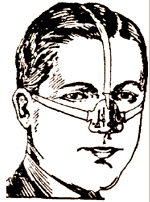
(1) In the years they spent sharing a roof with Michael Flannigan, they must have picked up some of his art of “locationism”, for this was a propitious neighborhood indeed. [back] (2) All except noted the eccentric cunnilingualist historian, Nasty T. Ung, as he outlines in his rather excrescent monograph, "The Triple-Threat Tarts: Dental Hygiene in Old New York's Irish Brothels." [back] (3) Not at all related to the famous Friar’s Club of today, though the early burlesque comedian, Stumpy McDink, was old enough to be a card-carrying member of both organizations. [back] (4) Surprisingly, the Tarts were still attractive enough to charge a premium for their services; no doubt this was due to the freakish Flannigan genome. [back] (5) The first instance of a bicycle-delivery service. [back] (6) Thudgar Lawrason was fitted with a well-designed prosthetic nose (made of pressed cheddar), after suffering a horrific wound in the Parkhill Shootout, circa. 1892. (Recounted in the excellent monograph: "Bulletproof: Michael Flannigan's Last Gunfight".) Never right in the head again, the Norwegian turned to a life of crime; he was the greatest getaway cyclist in the history of wheeled felonies, and the leader of the Norwegian Wheelemen, a small group of fierce bike-riding ruffians. His life of crime ended in 1911 when the New York police founded the motorcycle squad. Lawrason ended his days in Sing Sing, defending his nose from the rats with a shiv made out of an allen key. There is an additional coincidence. Prior to his de-nosing in 1892, he was a friend of Emily Chesley, the niece of the Friars Tarts. [back] (7) The sisters are mentioned prominently in the exquisite and touching monograph about the turn-of-the-century travel-writer, Jake LaFinger: "I Will Go On & You Will Probably Drown." [back] |
|
|
|
|
Emily's
Bio | The
Oeuvre | Flannigan
Bio | Inventions
Join our mailing list or send us email. All written material, graphics, logo, and html coding Web Monkey : Mark A. Rayner
|
 |
|