 |
Emily's Biography | The Oeuvre | Flannigan Bio | The Inventions |  |
| Associated Figures | Literary Contest | The Frolics Store | About the Circle |
|
|||||||||||
| Emily Chesley - a biography | |||||||||
|
|
|||||||||
|
Peruse her biography:Formation (1856-1880)London, Ontario (1880-1904) Travels (1904-1919) A Long Twilight (1919-1948) ...Chesleyan Timeline ...The Oeuvre
|
Wenches in the Trenches (1912 - 1918)
By the time her crowded Tasmanian transport hove into sight of the Golden Gate Bridge, Emily was itching to return to the relative anonymity of the mid-western plains she knew so well. (1) After a short but passionate train ride across the country, later immortalized in her poem "Lars of the Bar Car", she took up residence in a small garret in Chicago, and began work on a story inspired by a sinking ship she had seen in Hobart harbour. Scholars have speculated that Ratzan of the Ratz (2) could have made Chesley's fortune and reputation, had it ever been published, or even read for that matter. However, as had been the case in North Dakota, Ontario and France, Emily's mistake was in looking for love - and stationery - in all the wrong places (3), in this case the office of the Champlain Yardley Company. Seeking a man to fulfill her womanly needs, as well as some envelopes and a bottle of India ink, she met a struggling writer named Ed Burroughs, who was working there because his own pencil sharpener business had failed. Although Burroughs was a military man, having served in the 7th Cavalry in the Arizona Territory, he was definitely not Norwegian. Regardless, Emily fell into love once again or, at least, into bed. There, using rather a lot of pulleys and a loincloth - presumably attempting to sharpen his own dulled creative pencil - Burroughs positioned Emily's famously curvaceous buttocks in a sexually indescribable dangling tableau that recreated his first professional sale: Under the Moons of Mars. Apparently, Emily's posterior charms were not the only items that sparked Burroughs' interest; she woke up in the morning, still suspended from the rafters, to discover that he had made off with her envelopes, the loincloth, and her notes for Ratzan.
Despondent at yet another failed romance, and concerned
about events in Europe (such as the ongoing Pig War) (4),
Emily returned to England. Finding no immediate work as a writer, and
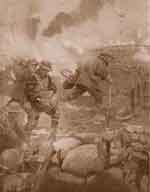
in search of ideas for the In protest against such travesties as TNT poisoning (7) among her fellow workers, Emily had herself packed in a crate filled with grenades (also known as "pomegranates") and shipped to the Front. In what may be an apocryphal story, the young subaltern who first pried the crate open at Ypres and found Emily snoring softly among the explosives is said to have cried, "Now that's what I call a bombshell!" Emily quickly found life in the trenches to be just as abysmal as life in the factories. The war in the trenches, set off in Bismarck's prophetic words by "Some damn foolish thing in the Balkans," (8) was a mucky affair, with soldiers frequently standing in water up to their ankles. This perpetual dampness - something that Emily knew quite a bit about - coupled with ill-fitting boots and long periods of immobility, caused a dreadful foot-swelling condition called "trench foot." In the minds of the British General Staff, this condition could be avoided through military discipline and good hygiene. While Emily had quite a lot of experience with the former through various sordid role-playing adventures, a recent parcel she had received from her uncle (9) allowed her to experiment with the latter. Flannigan's Digital-Vacuum Device (10), when used at the lower of two settings, helped soldiers rid their toes of unwanted mud and water, leading to a happy, healthy foot. Emily's work in treating trench foot earned her accolades from Dr. Alexander Fleming (11) of the Royal Army Medical Corps, among others. By chance, she also gained the attention of Sir Basil Thomson of British Military Intelligence (MI6) (12) when, in a tragic trench foot treatment incident, she discovered that the higher setting could remove toenails. This proved very helpful in interrogating captured German spies.
The general impression in my mind is of a nightmare. We have been in the most bitter of fights. For seventeen days and seventeen nights none of us have had our clothes off, nor our boots even, except occasionally. Scholars are bitterly divided about whether this excerpt refers to Emily Chesley and the Digital-Vacuum Device and, if so, whether the device was used for medicinal or more intimate purposes. The only other record of McCrae's interest in this area comes from fellow Canadian soldier, Throgmorton Spendawad, who was quoted after the war as saying that McCrae "really liked a good toe-sucking." Emily Chesley wasn't the only woman writer trolling the trenches for ideas and sexual partners. For a time, Emily shared a cordoned-off area of the living quarters with Edith Wharton, a New York socialite whom she had met in Paris, and who would subsequently write authoritative works on architecture, gardens, interior design and trench warfare. In 1917, Elizabeth Shepley Sergeant (13) moved in as well, having been sent by The New Republic to cover the war. Despite regulations that the "Ladies Only" portion of the accommodations should be treated as "No Man's Land," Emily and her fellow writers hosted a regular poker game in which Allied pilots frequently lost their shorts. In a memorable all-night game in July 1917, Canadian pilot Douglas Cunnel was down more than $100 to Emily. Holding four Aces, with the pot piled high, Captain Cunnel winked at his co-pilot 2nd Lieutenant Albert Woodbridge and cockily said, "I'll bet my plane you can't beat this hand." To his enormous chagrin, Emily smiled quietly, said, "Eventually, even Buckingham Palace is going to use Uncle Michael's Fecal Banishment Apparatus," and laid down a Royal Flush. (13.1)
The next day, Captain Cunnel's air wing engaged the German pilots of Jagdgeschwader Eins (Fighter Wing 1), and Cunnel was credited with shooting down its commander, Baron Manfred von Richthofen. (14) Scholars have never been able to reconcile the fact that Cunnel and Woodbridge were reported to be wandering naked through the trenches at the same time as they were supposedly shooting down the Red Baron, or that the pilots of the plane were described as laughing "girlishly" upon returning to the airfield. Whether hanging from pulleys or possibly flying biplanes, Emily Chesley's aerial adventures kept her busy during the Great War. While her writing production clearly suffered during this time, her sources of inspiration were many. On the 11th day of the 11th month, at the 11th hour (purely by coincidence), she set off in search of the opportunity and privacy to flesh out her multiple ideas, returning once more to the East, to the Valley of Bagrot. --"Scholarship" by the Flyboy
Notes: 1) This "burning desire" may simply have been a symptom of the "lead-poisoning" (also known as "a pencil case") Emily contracted in extricating herself from the clutches of Lord Gorcharp of the British Privy Council in the wake of the so-called "Chesley Sedition Case" (Back) 2) In this unpublished novella, Chesley's
protagonist Marcus Speetz, Lord Breaststroke, is orphaned in the urban
jungle of New York City. Raised by a kindly rat in the bowels of the city,
Speetz becomes a leader of a squeaky, cheese-nibbling tribe of prolific
defecators. Interestingly, this story is one of the few in which Chesley
consciously employs one of her uncle's (visionary Michael Flannigan) inventions:
Speetz goes blind while building miniscule Fecal Banishment Apparati for
each of the rats of the tribe, each equipped with tiny shoulder-straps.
Chesley's "always on, always connected" approach to sanitary
solutions is one of the first recorded instances of pervasive technology.
(Back) 3) It is speculated that country & western singer (and noted academic) Johnny Lee based his song "Looking for Love" on the life, times and sexual addiction of Emily Chesley. (Back) 4) The Pig War was a confrontation of the economic variety brought about by Austria-Hungary in an attempt to put an end to the Pan-Serb movement. It was the incident that tainted diplomatic relations between the countries and created the atmosphere that would lead to the events of 28-Jun-1914 in Sarajevo. The Pig War would be forgotten amid the events that would follow but it is an interesting case study in a foreign policy gone very wrong. (Back) 5) Founder, among other organizations, of the Anti-Sweating League in 1906. (Back) 6) In 1917, the British Minister of Munitions estimated that women were producing 80% of all weapons and shells. (Back) 7) This malady was thought to cause exploding hiccoughs. (Back) 8) The assassination of Archduke Franz Ferdinand of Austria-Hungary by seven Bosnian-Serb youths with tuberculosis and incomprehensible names. (Back) 9) Michael Flannigan mailed this parcel to his niece in time for Christmas 1900, one month prior to his death. Due to an unfortunate incident involving an untrustworthy employee of the US Postal Service (who, after interfering with Emily's mail was left with a decided limp), the package was not delivered until 1915. (Back) 10) The first DVD. (Back) 11) In 1928, drawing in part from a conversation he had had in the trenches with Emily about her bout of "lead-poisoning," Fleming first conceived of a drug he called jokingly "pencil"-icillin. (Back) 12) Ironically, Thomson's own career came to an end when he was arrested for committing an act of indecency in Hyde Park. (Back) 13) After returning to the United States, Sergeant moved to the southwest in 1920 and began writing about Pueblo Indians (and, presumably, their peyote-smoking habits). (Back) 13.1) Cunnel, a rather superstitious bloke, was indeed holding four aces -- war aces William George 'Billy' Barker, William Avery 'Billy' Bishop, Arthur Roy Brown and his co-pilot Albert Woodbridge. Cunnel often embraced his colleagues for good luck before leaving for missions over enemy lines, and was known to employ the same technique in hopes of bringing good fortune to his gambling exploits. Unfortunately, the cards he held in his hand against Chesley were not up to snuff on this fateful evening. What Cunnel in fact laid down on the table was a Full House - two jacks, three kings. (Foothills footnote) . [Back] 14) Although von Richthofen landed safely, he suffered a serious bullet wound to the head, and would suffer from terrible headaches until the end of his life. (Back)
|
||||||||
|
Join our mailing list or send us email. All written material, graphics, logo, and html coding Web Monkey: Mark A. Rayner
|
 |
||||||||


 next
section of her burgeoning literary oeuvre (a.k.a. "canon fodder"),
Emily took a job in the booming munitions industry. Working with trade
union leader Mary Macarthur
next
section of her burgeoning literary oeuvre (a.k.a. "canon fodder"),
Emily took a job in the booming munitions industry. Working with trade
union leader Mary Macarthur  Dr.
Fleming was not the only wartime physician believed to have entered Emily's
circle of influence. After the Second Battle of Ypres, Dr. John McCrae
- a Canadian - wrote the following to his mother:
Dr.
Fleming was not the only wartime physician believed to have entered Emily's
circle of influence. After the Second Battle of Ypres, Dr. John McCrae
- a Canadian - wrote the following to his mother: