 |
Emily's Biography | The Oeuvre | Flannigan Bio | The Inventions |  |
| Associated Figures | Literary Contest | The Frolics Store | About the Circle |
|
|||||||||||
| Michael Flannigan - a life of invention | ||||||||||

|
||||||||||
|
Michael Flannigan:
|
The Road to Heidelberg Part 4: The Bengali Bivalvular Rebreather After nearly six months of continuous flight from fanatical palace guards, blood-thirsty tribesmen and cut-throat bandits, Michael Flannigan and Desmond "Curry" Riffles were looking forward to a tranquil holiday. Through the spring and early summer of 1842, they were in good spirits as they traveled across the Indian subcontinent on horseback, heading for the sun-kissed beaches of the Bay of Bengal. Flannigan’s jaunty mood was evident in an excerpt from a letter to his dear sisters back in Ennis, County Clare:
Flannigan and Riffles were appalled by Sleeman’s characterization of the Thuggees – "villains as subtle, rapacious, and cruel as any who are to be met in the records of human depravity" – but were not particularly concerned about their own safety. After all, the Thuggees supposedly never attacked English travelers, and Sleeman claimed to have captured, then hanged or imprisoned most of the miscreants. You could have heard a pint drop[3], however, when Sleeman described the notorious but anonymous leader of the Thuggees, a man apparently well-known to the authorities, but never apprehended by them.
An entry in Flannigan’s journal, dated July 15, 1842, documents their astonishment at Sleeman’s next words:
Sleeman was unable to offer further information about the whereabouts of the Thuggee leader, so Flannigan and Riffles resumed their journey southward. With only brief stop in Madras to see the stately, magnificent East Indiamen frigates anchored half a mile offshore,[4] the two weary adventurers were eventually ensconced in a modest beach-front bungalow on the outskirts of Pondicherry. Michael Flannigan and Desmond "Curry" Riffles were indeed in need of a rest after their strenuous travels. However, despite Pondicherry’s rich historic tapestry[5] , the appeal of lounging languorously on this celebrated seashore quickly began to fade. For one thing, there were few bon bons to be found, and fewer femmes to be cherchez-ed. Further, while cricket bats continued to dot the landscape of their daily lives, there were bewilderingly few actual cricket matches to be watched… none, in fact. In the absence of other activities to distract him, it was no surprise that Flannigan’s razor-sharp mind began to peel the onion of science once again.
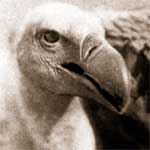
With the French form of "bird-watching" somewhat of a bust, Flannigan turned once again to his interest in the classical approach to avian observation. Using the FADAR[6], Flannigan spent the next few months identifying numerous local species including pelicans, storks and flamingos, as well as one of his favourite specimens, the Pondicherry vulture. Flannigan and Riffles spent hours enjoying the antics of this highly vocal bird, which produces loud roaring noises when mating. Having catalogued most of the indigenous birds, Flannigan was inspired to adapt the FADAR to identify local fish species. With Riffles at the oars of a borrowed rowboat, the two were soon sculling through the shallows of the Bay of Bengal seeking underwater enlightenment; however, the inherent darkness of the submerged environment proved an insurmountable challenge. Indefatigable and undaunted, Flannigan would not have given up this pursuit had he and Riffles not happened upon a rarely- recorded and little-known inshore shark of the Indo-Pacific, Carcharhinus hemiodon. An entry from Flannigan’s journal, dated December 7, 1842, records the encounter:
In fact, Desmond "Curry" Riffles had sustained only minor flesh wounds, but he was unable to grasp an oar (or anything else) for some time thereafter. Without propulsion, Flannigan’s nautical experimentation was temporarily curtailed. After a few days of contemplation, however, the inventor came up with a solution. Flannigan attached a small steam boiler to the centre seat of the rowboat, and refashioned the oars into a whirling contraption that he termed the "Sculling Contrivance for Rapid Excursions on Water" (also known as the "SCREW").[10] The mechanism was simple: steam from the boiler was channeled through a pipe to the stern of the boat, where it turned a gear which consequently drove the Sculling Contrivance. Although Michael Flannigan was not the first to envision a similar means of mechanized propulsion, he was certainly the first to do so in Pondicherry, and he is remembered there still for the words he shouted excitedly to Riffles as the floating conveyance he called his "motorboat" pulled away from the dock: "Look at me, Curry… I’m SCREWed!"
Flannigan’s words were prescient, and his exhilaration quickly turned to dismay, as he realized he had forgotten to install a steering device. As the increasingly terrified inventor clung to the rowboat’s prow, the high-powered but directionless craft wheeled madly about the bay, frightening seabirds and leaving a tremendous wake. Seemingly possessed, the small boat plowed across the face of an immense wave, banked furiously to the left, and aimed itself directly for the dock from which it had been launched. Flannigan and Riffles stared into each others’ eyes as the distance closed, each petrified. At the last moment, the steam-powered rowboat ricocheted off a large piece of driftwood, launching it into the air, over the dock, and inches from the nose of an awe-struck Desmond "Curry" Riffles. The last thing Michael Flannigan noticed before he lost consciousness as the flying rowboat landed in a banyan tree was yet another cricket bat that had been left lying about by what Riffles called "those bloody untidy Hindoos." Flannigan awoke sluggishly from a peculiar dream in which the powerful bagpipes of the striking Manx piper Connie Banks were pumping air down his throat as he searched the depths of Loch Ness in vain for its fabled monster. Struggling to move, Flannigan realized that the dream was quite real: he was strapped to what appeared to be a hospital bed, with a rubber tube in his mouth and two substantial women in black habits industriously working a matched set of bellows. Across the room, the prostrate inventor could see Riffles sitting in an armchair, his shark-nibbled hands swathed in bandages, reading aloud as he attempted to write yet another letter to his niece:
Flannigan quickly surmised that the hulking German nuns of St. Pity’s Sake Convent had saved his life with their own invention, a medical device which they called the Bengali Bivalvular Rebreather.[11] He vowed to repay the sisterhood for its efforts. As he recovered from his injuries, he conceived of a multitude of uses for their oxygen-pumping creation, including a compact steam-powered version that a swimmer could wear on his back. When he and Riffles left the convent some months later, Flannigan presented a jotting book full of notes and sketches to the Mother Superior. For years thereafter, the caring nuns of St. Pity’s Sake spoke Michael Flannigan’s name reverently as they blissfully tended the horrific burns and massive cranial injuries suffered by the men of Pondicherry who filled the convent’s sickbeds after using devices developed from the Irish inventor’s notes. --"Scholarship" by The Flyboy Part 5: Notes: 1. Flannigan could not have known that, within three years of this light-hearted comment, a combination of wet weather and an airborne pathogen would unleash potato blight (photophthora infestans) on the fields of Ireland. Widespread crop destruction led to famine, disease, and massive emigration. [back] 2. Sleeman is still commemorated in the name of the Indian village of Sleemanabad (where it is said that his picture still hangs in the police station). [back] 3. Which, as it happens, is almost exactly what occurred. To be accurate, it was two pints that hit the floor. [back] 4. Among the passengers disembarking that day into small wooden tenders was Alexander Arbuthnot, later hailed as one of the foremost civil servants in India. One of many cricket-playing civilians sent to perform Indian service, Arbuthnot founded the Madras Cricket Club in 1846. Chesleyan scholars suspect that Arbuthnot was inspired on his arrival in Madras (now Chennai) by the sight of Deepa Hada in her cricket bat guise, leaning coquettishly against a tree while patiently conducting surveillance on Riffles and Flannigan. [back] 5. Chesleyan scholars are fascinated by Pondicherry’s cultural significance: visits to its shores by the Romans and the Chinese; the advent, rise and fall of Buddhism; the resurgence of Hinduism; and the penetration of Christianity and Islam through two millennia. However, Michael Flannigan found it rather dull. [back] 6. Flannigan’s Avian Detection and Recognition Device. [back] 7. Chesleyan scholars suspect that the late, great author Douglas Adams was too busy writing some of the galaxy’s best novels to read Michael Flannigan’s journal. As a result, any similarity is purely coincidental. [back] 8. There is no evidence that Riffles ever played the flugelhorn previously, but he certainly never played it again. [back] 9. Franklin Roosevelt’s reuse of Flannigan’s phraseology 99 years later after the Japanese attack on Pearl Harbour suggests that the 32 nd President of the United States – unlike Douglas Adams – was an early Chesleyan scholar and avid reader of Flannigan’s journal. [back] 10. Flannigan’s unsuccessful patent application for the SCREW was stolen from the US Patent Office in 1924. Chesleyan scholars view it as sheer coincidence that the German inventor Felix Wankel conceived of the idea for his Wankel rotary engine that same year. [back] 11. Although long-forgotten, the Bengali Bivalvular Rebreather presaged the first modern and practical respirator – the "iron lung" – which was invented in 1927. The inventors used an iron box almost the length of a car and two vacuum cleaners to exert a push-pull motion on the paralyzed chests of polio sufferers. [back] |
|||||||||
| Emily's
Bio | The
Oeuvre | Flannigan
Bio | Inventions
Join our mailing list or send us email. All written material, graphics, logo, and html coding Web Monkey: Mark A. Rayner
|
|
|||||||||
![ecrc logo [link to homepage]](../../images/logo_duo_med.jpg)