Flannigan's Amplified Re-breathing Technology (1871)
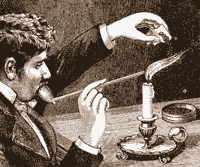 In
the early 1870s, Flannigan sought to recreate the wild success of his
Particulate Breathing Apparatus ("Party Brat") in the wilds
of North America. Knowing that the genteel and slow smoke that resulted
from a good puff on a Party Brat was less to the frontiersman's taste,
Flannigan created a new kind of pipe. Instead of putting the combustible
material within the bowl of the pipe, it was meant to be sprinkled liberally
over the open flame of a candle held before the smoker. The subsequent
rapid oxidization would result in a more powerful and immediate pleasure
as the smoker sucked the particulate in through the tiny opening at the
other end of the pipe. Unfortunately, most frontiersmen were unable to
master the trick of breathing in the smoke, without inhaling actual flame
and scorching their lungs. In the rough woods of Saskatchewan, this device
became known as the FART, and the process was colloquially known as "farting
the fire". (This phrase should not be confused with "firing
the fart", which was what happened after juvenile woodsmen ignited
the methane by-products caused by a meal of Uncle Rector's Lentil and
Gunpowder Surprise.) In
the early 1870s, Flannigan sought to recreate the wild success of his
Particulate Breathing Apparatus ("Party Brat") in the wilds
of North America. Knowing that the genteel and slow smoke that resulted
from a good puff on a Party Brat was less to the frontiersman's taste,
Flannigan created a new kind of pipe. Instead of putting the combustible
material within the bowl of the pipe, it was meant to be sprinkled liberally
over the open flame of a candle held before the smoker. The subsequent
rapid oxidization would result in a more powerful and immediate pleasure
as the smoker sucked the particulate in through the tiny opening at the
other end of the pipe. Unfortunately, most frontiersmen were unable to
master the trick of breathing in the smoke, without inhaling actual flame
and scorching their lungs. In the rough woods of Saskatchewan, this device
became known as the FART, and the process was colloquially known as "farting
the fire". (This phrase should not be confused with "firing
the fart", which was what happened after juvenile woodsmen ignited
the methane by-products caused by a meal of Uncle Rector's Lentil and
Gunpowder Surprise.)
| 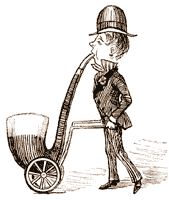
Winnipeg grain merchant enjoying a Follicle Restorer
and Big-Ass Pipe at the same time. |
Big-Ass Pipe (1877)
Still searching for a new device that would recreate his success in the
cannabis-smoking industry, Flannigan followed up the FART with his Big-Ass
Pipe (BAP). Constructed of a solid iron bowl and several water-cooled
chambers that led to the lips (Flannigan did not want any more lawsuits
due to thermal injury), the Big-Ass Pipe was an immediate hit in the Exchange
District of Winnipeg. Unfortunately, the mob-related difficulties he had
with another of his inventions, the Follicle Restorer, prevented him from
bringing the Big-Ass Pipe into full production. Interestingly, customers
who had purchased both a Follicle Restorer and a BAP did not seem to mind
the intense burning of the bird guano from their Follicle Restorers. Alas,
he did not think to sell these devices as a package. When Flannigan reached
London, Ontario, it was clear there would be no market for such a pleasurable
device as the BAP, and as with so many of his inventions, abandoned it
for new projects.
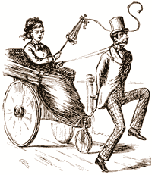 The
Twit-Powered Hackney (1862) The
Twit-Powered Hackney (1862)
Following a horrific outbreak in Tytism in 1861, Southeastern England
was inundated with victims of the disease. London, in particular, was
awash in twits. Sensing that this could be the right time for a device
that he had been working on for several years, Flannigan introduced the
Twit-Powered Hackney. Though not especially powerful, the new conveyance
was quite popular with ladies from the more genteel neighbourhoods, as
it was so easy for them to find a twit to harness to their vehicle.
Oversized Monkey Grinder (1855)
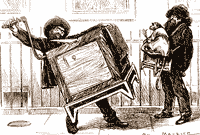 Working
on the erroneous theory that making something bigger makes something better,
Flannigan created the Oversized Monkey Grinder in the winter of 1855,
hoping to cash in on organ grinder mania, which had swept through London
in 1854. Unfortunately, Flannigan's timing was off with this invention,
not to mention his scale. In the spring of 1855 the New Cherksbury Organ
Grinder riot set off a backlash against the delightful instrument and
their aromatic players; in the fall of 1855 the government passed the
Monkey Grinder Act, which outlawed organ grinders and other itinerant
musicians from playing on the streets. This was repealed in 1856, but
the damage to Flannigan's market was already done, as most of London's
organ grinders had already emigrated to New York. Working
on the erroneous theory that making something bigger makes something better,
Flannigan created the Oversized Monkey Grinder in the winter of 1855,
hoping to cash in on organ grinder mania, which had swept through London
in 1854. Unfortunately, Flannigan's timing was off with this invention,
not to mention his scale. In the spring of 1855 the New Cherksbury Organ
Grinder riot set off a backlash against the delightful instrument and
their aromatic players; in the fall of 1855 the government passed the
Monkey Grinder Act, which outlawed organ grinders and other itinerant
musicians from playing on the streets. This was repealed in 1856, but
the damage to Flannigan's market was already done, as most of London's
organ grinders had already emigrated to New York.
--"Scholarship" by The Squire
|