|
Emily's Biography | The Oeuvre | Flannigan Bio | The Inventions |  |
| Associated Figures | Literary Contest | The Frolics Store | About the Circle |
Emily's Oeuvre
|
|||||||||||
Emily's Oeuvre |
|||||||||||
| (in)Complete
Works Original Fiction & Poetry Novel Gallery Chesleyan Chestnuts |
 |
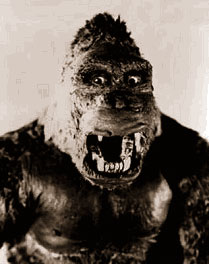
Written during the introspective period of the later 1880s, The Wonder was one of Emily Chesley’s early published works. Though the story lacks the depth and complexity of her later works, The Wonder shows a promising beginning for Chesley’s speculative imagination, as well as an interesting ability to weave the experiences of her own life into fantastical realms. Even more interesting are the remarkable events that inspired the work, as well as its influence upon later generations. The story takes place in the near future in St. Thomas Ontario. Emilia Chester is a young widow who has recently lost her husband – the strapping Norwegian farmer Vix Larsenger – in a tragic boulder tossing accident. Though the lonely Emilia is besieged by suitors, she remains isolated in her St. Thomas home. Emilia’s kindly uncle, the inventor Michael Winninger, tries to cheer up the despondent widow by taking her to nearby London to see a circus. In a large side show tent, Emilia beholds a caged great ape who is called, simply, The Wonder. She find herself intrigued by the huge beast. The Wonder, for his part, is clearly taken by Emilia. As she recounts:
Of course, the ape later escapes and carries off the screaming Emilia to have his way with her. The chase is on through the wilds of Middlesex County. Though physically repulsed by the The Wonder, Emilia gradually forms a kind of bond with the ape and feels sadness at his lonely state. In the climax to the story, Emilia pleads unsuccessfully for the ape’s life as it is cornered by members of a local artillery regiment. The story ends with the beast standing up, unsuccessfully, to a howitzer barrage.
The precedents of the story of The Wonder, include everything from Beauty and the Beast to Edgar Allan Poe’s 1841 story The Murders in the Rue Morgue. But there is more than simple literary inspiration here. There is also considerable biographical information as well. Though Emily Chesley was never married, and therefore never a widow, she did spend a considerable time in the early 1880s mourning the loss of the strapping Sgt. Lars Horstadt, a member of the 7th Regiment stationed in London. He died in the Victoria disaster of 1881 when his ample mustache became entangle in a mettle deck chair which dragged him to the bottom of the Thames river. Emily’s loneliness was further compounded in 1885 when the rest of the 7th Regiment went west to deal with the second Riel Rebellion. Though the 7th Regiment had left town – and Emily was being shunned due to the unspeakable Thong Bank incident – there were still (largely unwelcome) suitors about. One particularly loathsome individual was an overweight hirsute fish monger from the Covent Garden Market named Glover “Curly” Muff. In addition to being repulsive to look at, the love-struck Muff fancied himself a poet. Ignoring repeated requests to stop calling upon Emily, Muff would post truly awful love poems on trees and lamp posts all over the city – verse with titles like “My New Love Has Two Legs”, “I Saw Her In The Market Thumping a Cantaloupe”, and “My Love Is Like A Carp Fillet”. Though the poems were always anonymous, everybody in town knew their authorship as well as the focus of his affections.
Seeking to cheer up his despondent niece, Emily’s uncle – the inventor and locationist Michael Flannigan – offered to take her for a ride in his recently invented horseless carriage device, the Flannigan Flyer. Powered by a noxious combination of uric acid and bat guano, Flannigan created the Flyer in 1884 after Emily’s beloved horse Sparky suddenly died during a country outing. (Flannigan at the time was in the early stages of developing what would be a cheese-based underwear product that could later be shredded and fed to pets and farm animals. In retrospect he realized it was probably a bad idea to feed the prototype to Emily’s horse.) The Flyer was ready for a distance road test and Flannigan suggested that they drive his contraption to nearby St. Thomas, where the Barnum and Bailey Circus was making a brief stop. The couple’s drive to St. Thomas took a mere three hours and 45 minutes. They arrived just as the circus was preparing to embark on the Grand Truck Railroad. Little did Emily and Flannigan know that also on hand that fateful day in St. Thomas was Curly Muff. There were a number of circus elephants parading by an appreciative crowd. Among the elephants was Jumbo, a huge African elephant which the circus called a wonder of the world. There were a number of other elephants in the parade, such as the new baby elephant called Tom Thumb. In fact, there was 20 percent more pachyderm in St. Thomas that day than ever had appeared in London. Seeing the elephants parading by, to the obvious delight of the normally sullen Emily Chesley, Curly Muff hatched an insane plan. As the greatest of the circus elephants road by, his dearest love would look up to see Muff riding upon its back! Muff climbed to the top of a nearby rail car. As the giant pachyderm hulked by, Muff dived.
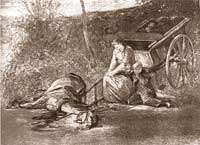
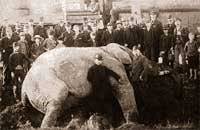
Feeling the sudden thump on his back, and already disturbed by the scent of bat guano and fish in the air, Jumbo bolted. There were screams of panic as the great elephant broke free from his handler and ran toward the crowd with Muff bouncing on his back. The crowd scrambled to get out of the way, children were snatched up by panic-stricken parents. Michael Flannigan ran to the nearby Flannigan Flyer to give chase. As Jumbo ran down toward the rail siding the distance sound of an approaching Grand Truck locomotive could be heard. Flannigan closed on Jumbo but it was clear he would not be able to head off disaster. Meanwhile Muff’s grip had become ever more precarious. As Jumbo reached the tracks Muff slide off the backside of the great elephant and under the wheels of the chasing Flannigan flyer. As the Flyer bumped over Muff, Flannigan swerved to avoid the oncoming train. Sadly the elephant was directly in the train’s path. The force of the collision derailed the train and drove poor Jumbo up and over and onto the severely injured Muff. In a matter of minutes, obscure St. Thomas Ontario earned dubious dual historical honors as the place where Jumbo the Elephant died, and as the first place anybody was ever run over by an automobile in Canada. (This second distinction has failed to make the history books as the Flannigan Flyer never caught on and has not been officially recognized as an automobile.)
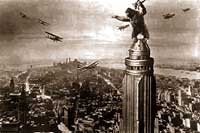
Unrequited love, beastliness, loneliness, and a climactic clash between a brute of nature and modern technology. They are all present in the story of Emily in St. Thomas as well as her subsequent work The Wonder. But the story doesn’t end there. The same themes have also suspiciously emerged in a 20th century story of a beauty and a great ape. The similarities between that story and the The Wonder are too numerous to catalogue. (Beginning with the title – King Kong the Eighth Wonder of the World). However, as The Wonder never saw wide release or critical acceptance, this scandal has been limited to a handful of Emily Chesley scholars. --"Scholarship" by Thuder |
||||||||||||
|
||||||||||||||
|
Emily's Bio
| The Oeuvre
| Flannigan Bio
| Inventions Join our mailing list or send us email. All written material, graphics, logo, and html coding Web Monkey: Mark A. Rayner |
|