Tag Archives | unicorns

A Brief History of Unicorns: Horny Greeks

Take a moment to think about some of your favorite Greek myths. Did Bellerephon ride a unicorn? No, he rode Perseus, the obviously fake winged horse. When Heracles (Hercules) was assigned the labor of cleaning the Augean Stables, were they filled with unicorns? No, the stables were filled with a 1,000 immortal cattle (and heroic defecators these cows were), thus ensuring an infinitely humiliating job. (Though Heracles spoiled the fun by rerouting a river through the stables.)

Pythagoras wearing his PHUD hornIn the vast wine-colored sea of rosy-fingered Greek myth, unicorns do not appear. Why? Because they existed, and Greek scholars wrote about them in their natural histories instead.

The Greeks (correctly) identified the origin of the unicorn in India, and described them as a kind of “fleet-footed ass with a horn a cubit long”. Ctesias said in his history of India, Indica, the unicorn was “fleet as the Western wind and as beautiful as a doe-eyed Athenian boy.” Aristotle thought the unicorn was the “most intelligent beast on the earth, save man,” while the philosopher Bungosias said the unicorn was “impossible to capture alive without the aid of a willing and guileful virgin, of which there are few in Hellas.”

Hunters had also been unable to bring down a unicorn with the use of stone- or bronze-tipped arrows, and it was not until the advent of iron that humans in Europe were able to kill the canny creatures. (The method that ancient Vedic cultures used to kill unicorns is lost to history, but the Greek loony historian, Kookooplas, suggested that ancient Indians had a surplus of female virgins, which were used to lure unicorns into a variety of clever traps.) Many philosophers engaged hunters to kill unicorns so they could be studied.

Though he is best known for his advances in mathematics, Pythagoras was also a believer in metempsychosis, or reincarnation. He thought it possible that human souls could be reborn in “higher animals” and naturally, as the most intelligent animal, unicorns would be an ideal receptacle for human sapience. Thus, Pythagoras thought it immoral to kill a unicorn, and formed an advocacy group, Philosophers for Honorable Unicorn Devotion (PHUD), to stop the slaughter.

Pythagoras apparently wrote a long treatise about the beasts called Unicornica; no doubt this was burned by disfigured and prurient monks in the dark ages. However, in one of Xenophanes’ surviving writings he spoke of Pythagoras’ belief:

“Pythagoras insists the Unicorns are intelligent and can speak in their fashion, communicating with flowers of differing color and species as we use the alphabet to form words. He has told them to leave our Hellas or to risk being hunted into extinction for their remarkable organs, and tasty, tasty flesh. That is why his PHUD-men wear the horn on their foreheads.”

This latter point is perhaps the most interesting aspect of Pythagorian unicorn worship, and explains the coin pictured above. Xenophanes then goes on to tell a rather boring story about attending a dinner party in which unicorn was served according to an ancient Vedic recipe.

And so it was the unicorns were driven further west, attempting to find someplace where they would be safe from the predatory humans. But word was out in Europe of their general deliciousness, and unicorns would not be safe again until the Middle Ages.

A Brief History of Unicorns

Part One: Getting Biblical
Part Two: Vedic Culinary Prescirptions
Part Three: The Golden Age of Unicorns
Part Four: Horny Greeks

Alltop is always horny, but it has nothing to do with unicorns. Pic via Wikipedia.

A Brief History of Unicorns: The Golden Age of Unicorns

neolithic cave paintings of unicorns, The Moravian Museum, Brno, Czech Republic

In ancient India, Unicorns faced an existential crisis. Not the kind where you doubted your role in life, but rather, the kind where your whole species was in danger of being turned into aphrodisiac soup.

Hence, the species of onus cornu moved west, where human civilization had yet to reach the dizzying heights it had in the east. There were signs of cities in the Levant and Greece, so the unicorns pushed on into Paleolithic Europe, settling in glades, glens and flower-bedecked forests throughout the continent.

At first, relations were a little rocky. The stone age humans living in Europe at the time found the unicorns a little stuck up, to be honest. They especially didn’t like how easy it was for unicorns to kill the dragons that had been plaguing the continent since the end of the last ice age. Then they realized, “hey, no dragons eating our virgins and defiling our young men,” (as everyone knows dragons are wont to do).

Thus began the Golden Age for the unicorns. Humans lived in peace with the golden-horned quadrupeds, even after it became apparent that the male unicorns were overtly fond of female human virgins of breeding age. (You see, it’s not just fundamentalist religions that are preoccupied with virgins, and there is a good reason for this: procreative Darwinian magic.) And to be fair, the male unicorns didn’t seem to mind if occasionally one of their female unicorn foals had it off with Thag the Caveman. (Who was known amongst all cave men as a degenerate of the first order, later defined by the historian Prudendus as unicornus humpus.)

Occasionally, there would be incursions of dragons, and the humans would help the unicorns drive them off, mostly by acting as bait.

Yes, it was an age as golden as their horns. But that was all about to change, as civilization extended its bony claws into this Eden, in the form of Metal. (Not the mullet-thrashing, head-banging kind, but the kind that helped you kill unicorns from a distance.)

A Brief History of Unicorns

Part One: Getting Biblical
Part Two: Vedic Culinary Prescriptions
Part Three: The Golden Age of Unicorns

Alltop loves to act as humor bait.

A Brief History of the Unicorn: Part One, The Bible

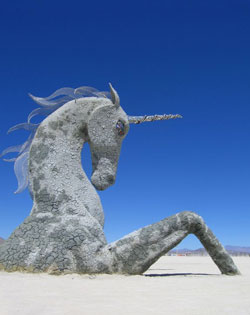
An arty photo of a kickass sculpture of a unicornWikipedia claims the unicorn is a mythological creature, and I call bullshit on that.

The unicorn is not mythological. The kraken is mythological. Jörmungandr, the Midgard Serpent, is a mythological beast. These are animals that defy logic and the physical rules of the universe — seriously, a snake that encircles the earth? The unicorn, however, is just a superior, yet extinct, animal.

The unicorn, or onus cornu, was once plentiful on the subcontinent of India, and in survived in secluded glades throughout Eurasia up through the 17th century, until humans hunted them into extinction. (As we are won’t to do with all the really cool animals, such as jabberwocky and jackalope.)

This brief series is intended to explain the nature of the unicorn, and its part in human history.

The Unicorn through the Ages

Part One: The Bible

References to unicorns are scattered throughout the historical record, no more obvious than in Deuteronomy, where Moses discusses the nature of the unicorn and God:

Adam looked at the beast, and said: “This shall be a horse.”

And to Jaweh he said, “truly lord, you are magnificent, what could be more awesome?”

The Earth shook, and Jaweh said, “screw you Adam. What could be more awesome. I am more awesome.”

And Adam said, “well, that goes without saying ye who have created, literally, everything. You are the tops. But I meant in terms of non-predatory beasts. What could be better than a horse? It’s fast. It carries a great load. It’s gait is proof of your existence. And it even smells nice.”

Jaweh said, “what if it smelled like marshmallows?”

And Adam asked, “oh tell me, Lord, what is a marshmallow?”

This just angered Jaweh, and he said, “you know what would make this more awesome? Something that let it kill predators. Like a giant freakin’ horn made of gold. And it should have a kick-ass beard like me, and something flashy for a tail. Like the one I did for the lion. And instead of a regular hoof, it has cloven hooves. And only virgins can ride them. And they shall be immensely strong.”

Adam was stunned by the beauty of the unicorn, and he wanted to ride it, but Jaweh said only Eve could ride it, and only before it had taken her as a man takes a woman.

And Adam said, “who is Eve?”

Jaweh said, “oh, right. We haven’t got there yet.”

Alltop definitely doesn’t smell like marshmallows. Photo of Mardi Storm sculpture via Gabe Gross.