|
Emily's Biography | The Oeuvre | Flannigan Bio | The Inventions |  |
| Associated Figures | Literary Contest | The Frolics Store | About the Circle |
|
|||||||||||
| Emily Chesley - a biography | |||||||||||
|
|
|||||||||||
|
Peruse her biography:Formation (1856-1880)London, Ontario (1880-1904) Travels (1904-1919) A Long Twilight (1919-1948) ...Chesleyan Timeline ...The Oeuvre
Educating Emily
|
Educating Emily
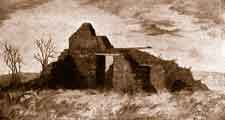
Emily's family took the North Pacific Railroad to its terminus, and ended up in a small farming community near what is now Williston. Fed a steady diet of science from Michael, Emily continued to read her beloved mythology, delighting especially in the bleak world view of the Norse. Perhaps it was this latter reading that left her in a frame of mind to throw herself at the un-named soldier who lived in the sod hut about two miles away. It was a long toss, and unfortunately, the Norwegian was unable to catch it due to a "sexually indescribable fencing wedgie". Emily was outraged and jilted him in a scene of such humiliation, his name has never been mentioned -- or recorded -- since. But the family once again found itself unwelcome and on the run. They followed the Missouri River west, then up the Frenchman (7) until they arrived in Saskatchewan, near what is now Unity. (8) The following year, Molly was murdered when a band of outlaws destroyed their sod hut, and raped their one remaining goat. (9) Given the very wildness of the times, and the fact that Emily seemed to be on very intimate terms with every horseman to come within shouting distance of their homestead, Michael decided that it was time to send her off to more formal education to the safety of a girl's school.
With the profits from his most recent invention -- the thong -- he enrolled Emily in the Evanston College for Women, in Evanston, Illinois. In the spring of 1871, Emily had just turned 16 and was nothing short of radiant. During their trek back through the frontier, Emily reflected on her mother's death, and was turning into a contemplative young woman. Throughout this period, Michael had been teaching her the sciences; of course, he could not teach what he did not know, so that did not include specific laws that, if ignored, could lead to explosive cranial bleeding and the words: "wa wa?" (10) At Evanston, Emily met the college's female president, Frances Willard, who later went on to found the Women's Christian Temperance Union. Though Emily found Willard's restrictions on sex and alcohol quite authoritarian, she was quite impressed by Willard's ability to put boneheaded male university administrators in their place. (11) She settled in nicely, taking to the classes and the extensive reading like a jockey to horseback, though the other women found Emily a little frightening. In her journal, Petunia Deecup, wrote: "The young Irish woman is brilliant, but a complete slattern. I swear that she has had intimate carnal knowledge of at least three of the custodians, and I suspect, that mannish girl Sally Degeneres."
For Emily the consequences were much more severe. Rumors that she had started the fire ran through the women's college like a naked nun in a friary. Taking the remains of Michael Flannigan's thong legacy with her, Emily headed east, to the nearest college that would accept her, Oberlin. She sent her uncle a letter letting him know where she had gone, but he did not receive it for several years. (12) At Oberlin, she was helped by the young and dashing Elisha Gray -- an American inventor who later contested the invention of the telephone with Alexander Graham Bell. (13) Gray was a longtime admirer of her uncle, and his protective feelings for Emily were certainly inflamed by her obvious physical charms.
While she was at Oberlin, Emily studied the classics and concurrently, the natural sciences. Though her relationship with Gray did not outlast 1872, Gray played an important role in her life, supporting her both financially and intellectually. She became more serious about her studies, and was inspired by Gray's ability to take fanciful notions and turn them into plausible ideas. Located in Ohio, just southwest of Cleveland, Oberlin is a strange place, which exists for the sake of the college. The campus itself has a peculiar appearance which some attribute to the: "Oberlin genius for strong-willed individualism; a certain otherworldly impracticality that flashes among us every now and then;... a certain brooding, anti-elitist mistrust for trained authority or deference to tradition."(14) Clearly Oberlin had a tremendous impact on the young Emily. Following the end of her relationship with Gray, no other dalliance appears in the historical record in her four years at the college. It was during this period, however, that she published her first short story, "The Loki Fire" in the school journal. She earned her A.B. in 1876, and went to meet her uncle in Winnipeg, where he hoped to revive his fortunes as an inventor. --"Scholarship" by The Squire Back to Educating Emily, Part One Notes: 7) Emily composed quite an amusing ditty at this time, called: "Froggy, Froggy, Do It Doggy, Doggy." [back] 8) Though in this period it was only small loosely-knit collection of rude dwellings filled with rank homesteaders and the occasional randy mounted policemen. [back] 9) Emily had ritually slain the others in an attempt to whither the private parts of every man in the Dakotas. [back] 10) The most spectacular gap in his knowledge was the Second Law of Motion, which led to "the uncouth sound of wet melon breaking open on pavement," when he invented the Southwark Sling. [back] 11) This is, incidentally, a skill that has been lost to subsequent generations. [back] 12) It took Flannigan quite some time to return to his mud shack in Unity, and upon reaching its sagging remains, he decided to head for North Battleford, where he heard a detachment of North West Mounted Police would be setting up shop, and establishing some order. The letter did not reach him until after he returned from a mission to test his new Hand Mortar. The details of this adventure are in the excellent monograph, Flannigan and the Cypress Hills Massacre. [back] 13) On Feb. 14, 1876, Gray filed with the U.S. Patent Office a caveat (an announcement of an invention he expected soon to patent) describing apparatus 'for transmitting vocal sounds telegraphically.' Unknown to Gray, Bell had only two hours earlier applied for an actual patent on an apparatus to accomplish the same end. It was later discovered, however, that the apparatus described in Gray's caveat would have worked, while that in Bell's patent would not have. After years of litigation, Bell was legally named the inventor of the telephone, although to many the question of who should be credited with the invention remained debatable. [back] 14) Geoffrey Blodgett, Oberlin Architecture: A short history (www.oberlin.edu/~EOG/gbslides/AShortHistory.html) [back]
|
||||||||||
|
Join our mailing list or send us email. All written material, graphics, logo, and html coding Web Monkey: Mark A. Rayner
|
 |
||||||||||

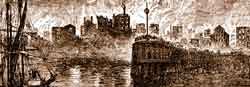
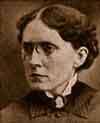 But
her dalliances all came to an end that glorious summer of 1871, when she
met a dashing young fireman with Scandinavian heritage; when he immigrated
to America he was Roald Thickarrson, but when he arrived, he changed his
name to Dick Thick. Throughout the summer, Dick and Emily were inseparable,
but in September, Emily no longer received gifts or visits from the fickle
Dick, and by October she had given up all hope of their young romance
blossoming to love. In what historians have hypothesized as her final
"outburst", Emily traveled to Chicago on October 8, 1871. That night the
great Chicago fire destroyed much of the city, and incidentally, the real
estate endowment which supported the Evanston College for Ladies. Its
president, Frances Willard, saw no recourse but to merge with Northwestern
University.
But
her dalliances all came to an end that glorious summer of 1871, when she
met a dashing young fireman with Scandinavian heritage; when he immigrated
to America he was Roald Thickarrson, but when he arrived, he changed his
name to Dick Thick. Throughout the summer, Dick and Emily were inseparable,
but in September, Emily no longer received gifts or visits from the fickle
Dick, and by October she had given up all hope of their young romance
blossoming to love. In what historians have hypothesized as her final
"outburst", Emily traveled to Chicago on October 8, 1871. That night the
great Chicago fire destroyed much of the city, and incidentally, the real
estate endowment which supported the Evanston College for Ladies. Its
president, Frances Willard, saw no recourse but to merge with Northwestern
University.