|
Emily's Biography | The Oeuvre | Flannigan Bio | The Inventions |  |
| Associated Figures | Literary Contest | The Frolics Store | About the Circle |
|
|||||||||||
| Emily Chesley - a biography | ||||||||||
|
|
||||||||||
|
Peruse her biography:Formation (1856-1880)London, Ontario (1880-1904) Travels (1904-1919) A Long Twilight (1919-1948) ...Chesleyan Timeline ...The Oeuvre
|
The Bi-Polar Years
With the case of sedition precipitously and suspiciously dropped, Emily found herself at loose ends in Britain. M.O. Venery, the current Secretary
General of the Canadian Congress of Speculationists had come all the
way from Canada to help win the legal battle, but he arrived at Victoria
Station the day it ended. Instead, Emily let him accompany her to visit
Lewis Carroll's gravesite in Guildford. Venery recalls this jaunt as
a happy time, which for him it no doubt was, being in Emily's company.
But the court case and the manner in which she defended her freedom
of speech lay heavily on Emily. She wrote in her journal: "The
British Empire is a stinking heap of camel droppings, and that damn
smirking Lord Mimsy Pustule Gorcharp is the chief dung beetle. I will
make them pay."
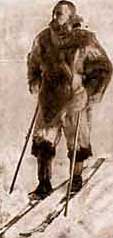
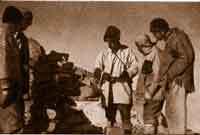
It was time to regenerate, to refresh her soul, to open new horizons, to have her own Chesleyan renaissance. In short, it was a time for Norwegians. Luckily, she was just a short ferry ride away. Venery, naturally, wished to accompany her to the newly independent country of Norway.(1) Emily had other plans for him though. When they parted ways in Guildford, Emily pressed a manuscript into Venery's hands, while planting a kiss on his cheek. She had composed the book while in prison and written it entirely from memory. This perhaps accounts for the incoherence exhibited in "Sabine Speculations". The bile and venom in the tale are very easy to understand. Venery printed it on his return to Canada as a serialized novel in the "Meanderings of the Canadian Congress of Speculationists". The uproar caused by its strange and disturbing imagery and its anti-British sentiment prevented Venery from getting it published as a book. (2) But Venery was already forgotten as she stepped off the North Sea ferry "Chunder" in Stavenger, Norway. From there, the next year of Emily's life reads like a who's who and where's where and a "By Thor's hammer, you're going to kill me woman" of Norway. There was Sven in Stavenger. Bjornsterjne in Bergen. Sigrid in Sognefjord. Lars in Lillehamer. Knud in Narvik. Heinrik in Hammerfest. Emily was later to write an excellent series of poems (The Norwegian Cycle) about it. While in Hammerfest, attempting to see if she could be the first woman to reach the North Pole, she met Captain Roald Amundsen -- a respected Norwegian explorer, who was the first to sail through the North-West Passage (1903-06). In Roald she met a kindred spirit: Ambitious, prone to fits of gas, and not afraid to eat a second helping of lutefisk. (3) Like Emily he loved the Systematic Anti-autointoxication Device, and even found a way to can a supply of yogurt for his expeditions. They discovered a mutual like of "exploration". With the North Pole recently crossed by Peary in 1909, Amundsen had set his sites on claiming the South Pole for Norway and all Norwegians. Leaving for Antarctica the next August in his ship the Fram, he told no one of his plans except his team, which included Emily. (4) History does not record Emily's participation in Amundsen's triumph in the Heroic Age of Polar Exploration, but some biographers have commented on the 'closeness' between Amundsen, and Helmer Hanssen, one of the expert dog-drivers on his polar expedition. (5) Indeed, Olav Bjaaland - a skiing champion and member of the South polar expedition commented in his journal: 29 December, 1911. After a day of hard driving, we reached the top of the Axel Heiberg Glacier in high winds and thick snow drifts. Though Roald is fair with all of us, he showers effusive praise on Helmer, for merely doing his job, which he does well. I have noticed, and would not dare to comment to my comrades, that Roald and Helmer always seem to bunk down next to one another in the tent. (And of course, the scent of his seal-skin skivvies has a lingering richness which I fear will haunt me for the rest of my days. Perhaps I have been too long away from women.) While there is little doubt it was the use of sled dogs and Amundsen's excellent planning skills that enabled the Norwegians to reach the pole before the ill-fated Scott expedition, it is also clear that something extraordinary was driving Amundsen on, which is revealed in his journal entry:
Was it patriotism, or was it Emily's fervent anti-British sentiments that so drove the explorer? It is one of history's unanswered questions. However, as Amundsen and his expedition left Antarctica to wire the news to the world, things were not going so well for the Scott expedition.(6) When Emily finally heard of their demise in February 1913, something had softened in her. Instead of glee at the failure of the British expedition, her tone was conciliatory in the haunting and lyrical poem: "Frozen on the Spot Scott". (Though it must be noted that the British press did find it "crude and tactless.") Emily returned to North America in 1912; having satiated her need for Norwegians, she left Roald in Tasmania, and took ship for America, landing in San Francisco in May. It was during this long sea voyage that she read Jung's "The Psychology of the Unconscious" and was deeply influenced by the idea of extroverted and introverted personalities. Emily presciently extended this concept to societies, anticipating the coming of Fascism (as a dangerously extroverted society) in her astonishing 1913 book: "The Warlord of West McGillivary". She also started work on her memoirs, simply titled, "Speculations", the first chapters of which concerned her adventures in the Yukon, Norway and of course, the South Pole. --"Scholarship" by The Squire Next: Wenches in the Trenches (1912-1918) ----------------------------- Notes:
|
|||||||||
|
Join our mailing list or send us email. All written material, graphics, logo, and html coding Web Monkey: Mark A. Rayner
|
 |
|||||||||