 |
Emily's Biography | The Oeuvre | Flannigan Bio | The Inventions |  |
| Associated Figures | Literary Contest | The Frolics Store | About the Circle |
|
|||||||||||
| Emily Chesley - a biography | |||||||||
|
|
|||||||||
|
Peruse her biography:Formation (1856-1880)London, Ontario (1880-1904) Travels (1904-1919) A Long Twilight (1919-1948) ...Chesleyan Timeline ...The Oeuvre
East of Etonne
|
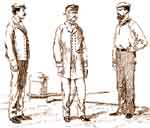
East of Etonne: Norwegian Seamen
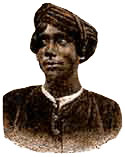
During the long journey across the subcontinent Emily, always open to new ideas, studied the local customs and culture. She was particularly taken with erotic depictions carved into many a temple wall. It was during this journey that she was introduced to the Kama Sutra by a number of able and willing teachers. (2.1) At the end of March, 1919 Emily arrived at the ancient East coast port of Pondicherry still feeling ennui but also muscle spasms and a sore back. As luck would have it a Norwegian steamer, the Yawl, was leaving to carry pepper to Vancouver and could billet a passenger. Emily, who was short of cash, was able to book passage by promising to counsel the sailors in a number of ancient Indian relaxation techniques which would make the long voyage more palatable. On the long journey across the Pacific Emily counseled many a lonely sailor. The trip was otherwise uneventful though it mysteriously took two weeks longer to reach port than expected even though the weather was remarkably good for the entire trip. Bidding a fond farewell to the smiling Norwegians at Vancouver, Emily climbed aboard the Canadian Pacific for the long ride to Ontario. It was the end of May and spring was in the air in Canada and Emily was looking forward to the lovely sights of the Rockies and her childhood home on the Prairies. But there were storm clouds on the horizon. Across the prairies simmering labor unrest was about to explode into an historic confrontation and the closest thing to a worker revolution ever witnessed in North America.
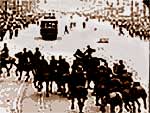
Winnipeg Emily's excitement was somewhat dimmed, however, when she met with the strikers. Two weeks of strike had worn heavy on many of them. She feared the strike might be on the verge of collapsing. Never had there been a moment more suited for Emily's many talents. She immediately set to work. By day she gave fiery speeches to the strikers and wrote scathing critiques of Winnipeg's upper crust. In the evenings she counseled in ancient Indian relaxation methods. The spirit of the strikers was noticeably raised. Emily also went about organizing a brigade of local women to service the strikers with her counseling techniques. This "provision of services" was an inspiration to many striking professionals and tradesmen who too began to provide services. Soon the trolleys were running, milk was being delivered, and the streets were being cleaned. The workers were doing it all on their own!
With growing horror the feckless elite began to talk of Bolshevism and Revolution. The government agreed and it was resolved that the strike would be crushed. This occurred on June 21, 1919, when the North West Mounted Police charged into un-arm crowd of demonstrators. Groups of "Special Police" (baseball bat armed thugs) finished what the police had started. Two strikers were killed and 30 injured. London to London Emily found writing The Pestilence to be a cathartic experience. As the days grew short and lovely Ontario summer gave way to the brisk fall, Emily thought of travel once again. She delivered her latest manuscript in person to the Toronto offices of publisher Big Nose Printing. Collecting an advance against royalties for the book she went on to Montreal and Halifax where she boarded the luxury liner Caledonia bound for Dover. October found Emily back in London living in the rented flat where her incredible odyssey had begun. One evening she accepted an invitation from a friend to attend a reading at the Exeter College Essay Club at Oxford. That evening a young war veteran performed his first public reading of one of his works of fantasy, The Fall of Gondolin. Emily was quite taken by the young man, perhaps because of his obvious talent or maybe because his second middle name Reuel sounded somewhat Norwegian.
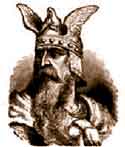
A year later at Leeds University, Tolkien established the Viking Club, a circle of undergraduates who focused on dressing up as Norsemen, reading old Norse sagas, and drinking beer. The chesleyan influence here, as well as in much of Tolkien's writing is clear. --"Scholarship" by Thuder <...Back to East of Etonne: part one Next: The Busy Autumn (1919)...> Notes: 2.1) One of her teachers was Mohatma Gandhi, who she had first met in Durban, South Africa in 1899 while traveling the Transvaal with Karl de Wittgen. Gandhi, who had since become India's great spiritual leader, had much in common with Emily. Just as she had been charged with sedition against the crown in 1908, Gandhi would be arrested by British authorities on charges of sedition three years later in Bombay. (Foothills Footnote) [back] 3) The fact that one of Emily's favorite India-inspired "relaxation techniques" is titled The Two Towers is considered entirely coincidental. [back]
|
||||||||
|
Join our mailing list or send us email. All written material, graphics, logo, and html coding Web Monkey: Mark A. Rayner
|
 |
||||||||

 There
is no evidence that Emily and the young man, who had a wife and young
child, had anything more than a Platonic relationship or that he ever
saw the inside of Emily's fabled "frolics trunk". Whatever the
nature of the relationship, there is no doubt that the mature and experienced
Emily had a profound influence upon the impressionable John
Ronald Reuel Tolkien.
There
is no evidence that Emily and the young man, who had a wife and young
child, had anything more than a Platonic relationship or that he ever
saw the inside of Emily's fabled "frolics trunk". Whatever the
nature of the relationship, there is no doubt that the mature and experienced
Emily had a profound influence upon the impressionable John
Ronald Reuel Tolkien.