|
Emily's Biography | The Oeuvre | Flannigan Bio | The Inventions |  |
| Associated Figures | Literary Contest | The Frolics Store | About the Circle |
|
|||||||||||
| Emily Chesley - a biography | |||||||
|
|
|||||||
|
Peruse her biography:Formation (1856-1880)London, Ontario (1880-1904) Travels (1904-1919) A Long Twilight (1919-1948) ...Chesleyan Timeline ...The Oeuvre
The Penultimate Years Part
1: Clichy
|
The Penultimate Years: Part 5: Encore St. Pol-sur-Mer
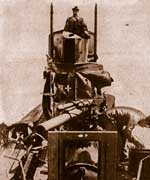
Confused about her heritage, and concerned for the future of the western world, Emily returned to the comforting surroundings of tiny St. Pol-sur-Mer. Little had changed in the village in the nine years that Emily had largely been absent, save that thick moustaches had advanced upon the upper lips of several young fishermen where formerly only silky wisps had held sway. Emily's protégé Veracity had come into her own as the Madam of Mental Massage, so Emily simply took up residence and enjoyed once again the company of thinking men, including many British and French soldiers. Even in the remote village of St. Pol-sur-Mer, news of the war arrived daily. Emily wept when she read that Hitler had invaded Norway on April 9th, 1940. Of more imminent concern, though, were the tidings that the German war machine had invaded France. Then, after months of "phony war," the German army suddenly launched a knockout blow. As Allied defences collapsed and the Germans swept towards the key targets of Paris and the Channel ports, hundreds of thousands of defeated British and French troops were surrounded in the not-yet-conquered territory that surrounded Dunkerque. The Jerries were advancing, and lives were at stake. Emily knew what she had to do. She instructed Veracity to place a call to the British commander, Viscount Gort, and provided a precise message to be delivered. Then, mounting her trusty bicycle, she set out for the armoured Panzer divisions that waited around the perimeter of Dunkerque. Not even the erudite scholars of the Chesley Institute can say for certain what happened next. Some scholars suggest Emily held off the Germans single-handedly in a large-scale session of The Pomegranate Club. Others believe her role was more subtle, influencing the German commanders to take a short break for some "relaxation." Regardless, in what has become known as the "Miracle of Dunkirk," the German armies waited outside the town just long enough for British navy ships and every available civilian boat to take the trapped soldiers off the sandy beaches. Some troops didn't want to be evacuated, preferring to face the advancing steel wall of German tanks rather than forsake their weekly visit to Emily's parlour. However, the choice was not theirs to make and, by June 4, 1940 the evacuation was complete. Veracity Best remained in St. Pol-sur-Mer for the duration of the war, and is reported to have used The Pomegranate Club as a refuge for members of the French Underground. For her part, Emily dodged the German armies and used her rowboat to slip into the English Channel under cover of darkness. It was a long and dangerous trip from Dunkerque to Ramsgate, but she knew she had no choice but to risk it. Halfway across the Channel, Emily was sure her choice had been foolish, and would soon prove fatal. In 10 foot seas, drenched to the skin, with her damp pipe clenched in chattering teeth, she suspected she had seen her last Norwegian. What a surprise she had when her rowboat was capsized by the surfacing of a submarine bearing the name B-5 and the markings of the Royal Norwegian Navy. Floating in the frigid sea, she used her pipe to pound on the submarine's hull and, shortly, was rewarded by the opening of the conning tower hatch. The sopping wet Speculative Songstress of the Southwest was hauled out of the icy waters by two blond Nordic giants in roll-neck sweaters, and her heart soared.
Emily's short hair was plastered to her forehead, her dark wool suit and tie were soaking wet, and she had a small grease smudge on her upper lip, but she was nevertheless profoundly happy. Oh, to be once again in the arms of Norwegians! How surprised she was when the submarine commander clicked his heels together, flipped up his hand in an open-palmed salute, and barked "Heil Hitler!" while groveling severely. It took a moment for Emily's chilled mind to unravel this case of mistaken identity, and to come to terms with her confusion about the nationality of her rescuers. For the strapping sailors were not Haralds, Einars, Arvids or Olafs, and the vessel no longer sailed under the flag of Norway . Instead, the splendid submariners were Manfreds, Reinhards, Wolfgangs and Fritzes, and former Norwegian submarine B-5 was now designated UC-1 of the German U-Bootwaffe.[15] With a start, the dripping author realized she had been captured by the Nazis. Never one to pass up an interesting opportunity, Emily Chesley looked Kapitan-Leutnant Wilhelm Kiesewetter squarely in his monocle and uttered - for the first time - the line that has since launched a thousand speculative ships: "Take me to your leader." --"Scholarship" by the Flyboy Next Chapter: The Big Finish
---------------------------------- [15] B-5 was captured on April 9, 1940 at Kristiansand, Norway and commissioned into German service. Other than capturing Emily Chesley, Kplt. Kiesewatter had no notable naval successes and UC-1 was broken up in 1942.
|
||||||
|
Join our mailing list or send us email. All written material, graphics, logo, and html coding Web Monkey: Mark A. Rayner
|
 |
||||||