|
Emily's Biography | The Oeuvre | Flannigan Bio | The Inventions |  |
| Associated Figures | Literary Contest | The Frolics Store | About the Circle |
Emily's Oeuvre
|
|||||||||||
Emily's Oeuvre |
|||||||||||
| (in)Complete
Works Original Fiction & Poetry Novel Gallery Chesleyan Chestnuts
Read the poem, |
 |
The
Chesley Carp Controversy
None-the-less carp flourished in Canada supplanting native garbage fish such as the Lurgan, the Headless Eel, and the Spotted Mud Sticker. Over the century there were several attempts to make the Canadian carp commercially viable. In 1878 a Scot farmer from Embro named Angus “Siltyback” McSquingy tried to popularize a sport of his own invention called Carp Kissing. A difficult sport, the participant had to master a tricky back stroke along the river bottom (called the McSquingy Crawl) so as to position himself below a really big bottom feeding carp. The one and only Carp Kissing tournament, held in nearby Tavistock in 1880, was called off when several participants became stuck in the river mud and were unable to surface. McSquingy gave up Carp Kissing in favor of the more sensible Scottish sports of telephone pole tossing, boulder carrying and, of course, golf.
By the turn of the century the lowly carp would have become but a forgotten garbage fish if not for the resurgence in England of carp fishing as a sport. Emily Chesley, who having a rough go of it at the hands of the Privy Council, found the English enthusiasm for carp fishing both amusing and repugnant. "Why don’t they just drag the bottom for sunken logs," she was overheard saying at a garden party in Devon in 1908. The remark was quoted in a local newspaper story "Canadian Woman Mocks Manly Sport" adding additional unwanted negative publicity to an already troubled reputation. Upon her return to Canada, Emily found that Carp fishing was also becoming popular in this country. Moved as much by a growing hatred of the English as by a deep knowledge of angling, Emily penned the poem "Idiots and The English Catch Carp In Ontario" somewhere around 1910. The poem, which attacks the English penchant for carp fishing in urban industrial areas, was not particularly well written or accurate. (Carp fishing is a tradition in many cultures especially in Eastern Europe. The Irish too are known to fish carp.) Still, it should be noted that even to this day English anglers visiting Canada would just as rather fish for carp in Southern Ontario as seek out great Canadian game fish in more remote locations. Though the poem was never published it sparked considerable controversy years after Emily’s death when it was found among some old papers. The controversy stems from the poem’s striking similarity to a 1932 song written by Noel Coward which lampoons Englishmen and mad dogs. Dr. O. Wynnott Stroak, an early devotee of the "lost works" of Emily Chesley, noted the similarities in his landmark monograph on the literary expropriation of the Chesleyan ouvre by 20th century writers "This Is Bullshit!". After a careful, phrase by phrase comparison of the two works, Stroak concluded that Coward was "A big fat faking fake faker!" Unfortunately, Stroak was soon widely discredited not because of his Emily scholarship but due to an unrelated belief that penguins could be taught Olympic synchronized swimming. Some believe that Stroak’s academic demise was part of larger conspiracy to eradicate Emily Chesley from literary history. In some of these conspiracy theories the Royal Family have been implicated and, in others, Norwegians are involved. Regardless of the veracity of these claims, the fact remains that today the Chesley Carp Controversy is only controversial among a small band of Chesleyan scholars. Read the poem, "Idiots and The English Catch Carp In Ontario"...> Addendum Some have suggested that "Idiots and The English Catch Carp In Ontario" might be the worst poem ever written that features carp. However this honor goes to William Thudworth St. John Smith, poet laureate of Spidgy-On-The-Thames, for his not quite memorable ditty, "Ode to a dead carp on the river bank". --"Scholarship" by Thuder. |
||||
|
||||||
|
Emily's Bio
| The Oeuvre
| Flannigan Bio
| Inventions Join our mailing list or send us email. All written material, graphics, logo, and html coding Web Monkey: Mark A. Rayner |
|
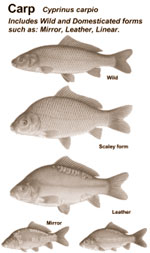 The
fish that would be at the center of an Emily Chesley literary controversy
is not native to Canadian waters. It was brought to Canada early in the
1800s by English anglers who thought it would make an excellent sport
fish and food source for hungry colonists. But though carp have a history
as a food fish going back to 400 BC, the big slow moving mud suckers never
really caught on as an eating fish in Canada, particularly since local
waters were teaming with better tasting trout. The lowly carp soon became
known as a garbage fish, best buried in the garden for fertilizer if caught
by accident.
The
fish that would be at the center of an Emily Chesley literary controversy
is not native to Canadian waters. It was brought to Canada early in the
1800s by English anglers who thought it would make an excellent sport
fish and food source for hungry colonists. But though carp have a history
as a food fish going back to 400 BC, the big slow moving mud suckers never
really caught on as an eating fish in Canada, particularly since local
waters were teaming with better tasting trout. The lowly carp soon became
known as a garbage fish, best buried in the garden for fertilizer if caught
by accident. 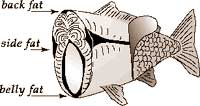 Emily’s
Chesley’s uncle, Michael Flannigan, also had a brief flirtation
with carp commercialization in the 1890s when he devised the Flannigan
Carp Diet. Seen as an inexpensive and healthy use of a local resource,
the diet featured not only carp meat, but eggs, eyes, viscera, and oil.
Believing that the hearty carp might hold the secret to a long and healthy
life, Flannigan fed a group of volunteer medical students from the fledgling
Western Ontario University nothing but carp products for a month. He abandoned
the experiment when the volunteers began to insist on wallowing lethargically
in shallow pools of water and claimed to constantly crave creamed corn.
(Years later it was proved that carp had nothing to do with this behavior
and it is instead an aberration exhibited by the type of people attracted
to medicine at Western.)
Emily’s
Chesley’s uncle, Michael Flannigan, also had a brief flirtation
with carp commercialization in the 1890s when he devised the Flannigan
Carp Diet. Seen as an inexpensive and healthy use of a local resource,
the diet featured not only carp meat, but eggs, eyes, viscera, and oil.
Believing that the hearty carp might hold the secret to a long and healthy
life, Flannigan fed a group of volunteer medical students from the fledgling
Western Ontario University nothing but carp products for a month. He abandoned
the experiment when the volunteers began to insist on wallowing lethargically
in shallow pools of water and claimed to constantly crave creamed corn.
(Years later it was proved that carp had nothing to do with this behavior
and it is instead an aberration exhibited by the type of people attracted
to medicine at Western.)