|
Emily's Biography | The Oeuvre | Flannigan Bio | The Inventions |  |
| Associated Figures | Literary Contest | The Frolics Store | About the Circle |
|
|||||||||||
| Emily Chesley - a biography | |||||||||
|
|
|||||||||
|
Peruse her biography:Formation (1856-1880)London, Ontario (1880-1904) Travels (1904-1919) A Long Twilight (1919-1948) ...Chesleyan Timeline ...The Oeuvre
|
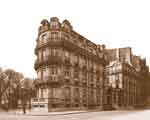
The Paris Years (1904-1908)
Apart from the constant murmer of a poorly tuned harp, and the occasional cackle of "Sieve? Sieve! Bwah Ha ha ha!" from the gallery, Chesley's address to the First Canadian Congress of Speculationists was an unblemished success. Her acceptance by the Congress marked a turning point in her career. (1) Never again would she be unknown and unread by her peers. She would only be unknown and unready by the public at large. At the Congress, Emily was persuaded by the new Secretary General, M. O. Venery, to take up the pen again. (In particular he hoped that she'd: "write something really saucy.") She took him at his word, literally, and re-worked The Arvan Atavists -- a penny dreadful that she'd written under her pen-name of Lady Harriet Bloomer-Shitz - as a new story, The Dutton Cannibals. Though it was not as crude as her earlier work, the appendix of "sauce" recipies was unfortunate. "Braised babies with carrot ragout" was particularly misguided, and earned this censure from Arva's Rev. Martin Bunmuncher: "Not since that horrid book by Lady Bloomer-Schitz have I read such excrescence."
But Emily was undaunted by such condemnation, particularly from the Anglican clergy. This led her to new artistic depths in The Party Brat. Not only was this a watershed work for her in the sense that it was her first novel that could not entirely be described as speculative, but it also embraced the movement of expressionism. It was this book - or to be more accurate, the burning of this book - that brought Emily to the notice of Henri Matisse, and his fauvist colleagues in Paris. Emily received a letter from Matisse about 10 days afer the burning of The Party Brat in Victoria Park, and Rev. P. E. Derasty's call for the author's immolation as well. (2) Matisse lightheartedly invited Emily for a visit, to see how a "civilized" people greeted challenging art. Henri (and particularly his wife Amélie) were quite surprised to discover the middle-aged (but still gorgeous) Emily on their doorstep within the month. Emily arrived in the Matisse household like a bomb. But it was a creative explosive. It was during this period that Matisse painted his ground-breaking fauvist work, The Blue Nude (there is even some speculation that Emily modeled for him) and at the same time, Emily herself was busy. In this period, she penned several short works, including: "The Zuzus of Pneu", and "Farthingham's Fardle's Bardles", both later published in The Meanderings of the Canadian Congress of Speculationists.
But life chez Matisse was not going well. There were too many Emilies. When Henri left to spend the summer with André Derain at Collioure, his wife politely asked Emily to leave. Actually, a report in Le Monde Gossipe, described the conversation as "une guerre des chats extraordinaire". Leaving the house and the bald mistress behind, Emily soon found her way to Picasso's atelier, where he was busy screwing everything that moved. He was also busy on this wacky new concept, cubism. (It was a decade of "isms".) In exchange for her 'modeling' services, Picasso let Emily stay with him in a small garret. (3) Apart from a short trip to a Bavarian spa town, Emily worked 1905 through 1907 in the small room, feverishly producing short stories, essays and a horrific failure of a novel, Eating Mr. Lumpy.(4) Apart from her obsession with cannibalism, Emily hammered away at her two most cherished themes - the necessity of sexual freedom for women, and the evils of the British Empire. As a writer practically in exile, she had bonafide credentials as both an social activist and quasi-martyr. Her essay in the London Geezer-Times and Sunday Shopper, "In favour of Sinn Fein" finally brought the unwanted attention of Whitehall to her work. The central thesis of her work was that if Einstien could turn physics on its head (he had just published his Theory of Relativity) then certainly, every good citizen of the world should question the value of the British Empire. While in Paris, Emily also had occasion to meet the famous Nobel Prize-winning scientist, Marie Curie. Curie was intrigued by Chesley, and often had her over for tea and "radium buns". In late September, 1907, Emily wrote in her diary: Madame Curie is in many ways, my paragon. If only I could have chosen the field of science, where it seems, a woman is allowed to flourish. Or perhaps it is only the fact that I had the misfortune to be born into the British Empire, a woman, and Irish to boot. Madame Curie has encouraged me to continue my good work with the "CU", and I plan to do just that (5). Emily left Paris, and was immediately arrested when she arrived in London (England) on her way to visit Lewis Carroll's grave. The authorities had her imprisoned, and there she languished for nearly six months, without charges being brought up against her. However, she had sent a note to her stalwarts in the CU telling her of her travel plans, and they knew enough to let the Canadian Congress of Speculationists know she was missing. M. O. Venery, who was becoming Emily's greatest fan despite the bewildering strangeness of Eating Mr. Lumpy, rushed to England to get her out of the clink. But Chesley was already well on the way to getting herself out of jail. When they finally dragged her into court, Emily found herself in front of the Privy Council, ably defending herself against a charge of sedition. In the main, the evidence against her was the essay supporting Arthur Griffith and his new movement to free Ireland from British tyranny. However, there was also a twelve-page letter from "one of her colleagues" in the colonies, which outlined her speech at the First Congress, including its rousing end. Chesley's reference to the Empire as an "autocratic regime, rife with a paterfamilias ethic" initially set the Council against her. Quentin Farkmee had struck again. However, within two days of that evidence being brought forward, all charges were dropped. Venery arrived just in time to escort Emily up to Carroll's grave before she headed east. To this day, there is no record of how she convinced the Privy Council to set her free, but whenever asked about the case, Lord Reginald Pustule Gorcharp (his friends called him "Mimsy") would smile, look into the distance wistfully, and say: "Ah, the Chesley Sedition Case. Now there was a woman who could put a bit of the old lead in your pencil." --"Scholarship" by The Squire Next: The Bi-Polar Years Notes:
|
||||||||
|
Join our mailing list or send us email. All written material, graphics, logo, and html coding Web Monkey: Mark A. Rayner
|
 |
||||||||