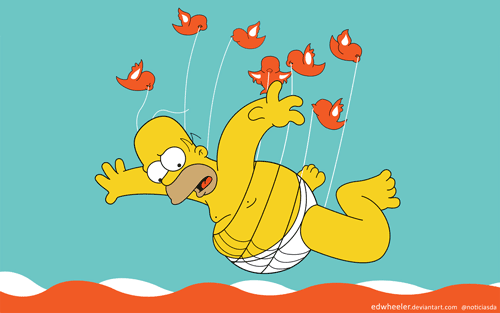
“Now I will destroy the whole world.”
– What Bokonists say when they commit suicide, Cat’s Cradle, Chapter 106
 You’d think a story about the end of the world – not just the world of one person, or human civilization, but all life on the planet – would be a grim affair, but Kurt Vonnegut’s Cat’s Cradle is replete with wit, wry humour, and a touching compassion for human frailty.
Vonnegut’s book is no bright dystopia, like the one portrayed in Aldous Huxley’s Brave New World, nor is it as unrelentingly dark as George Orwell’s 1984. It’s our world that Vonnegut so amusingly satirizes, a world in which human beings are awfully good at creating doomsday devices (atomic bombs, religions), and lying to themselves.
Many have said this is a story about the insanity of the Cold War, but I think it’s a short history of human stupidity. And it is as relevant today as it was when it was first published in 1963. The plot follows a narrator who is writing a book about one of the creators of the atomic bomb and in the process discovers the scientist has also made Ice-9, a substance with the potential to turn all water into solid ice. Why invent such a dangerous thing? Come on, science can’t be held back by such existential worries – it’s progress, baby.
Our world is beset with climate change caused by our technologies. As a species, we’re on the cusp of massive changes that could exceed the pace of evolution – whether from genetic engineering or through fusing our biology with information technology – and this is precisely the kind of book that everyone needs to read.
We need to think about what we are doing with our scientific power, not just proceed blindly.
Cat’s Cradle is the book that helped me find a way I could be a writer: it’s literary, but it plays with science fictional tropes; it’s funny, but there’s a point to it all. In it he invents a religion, Bokonism, that is both humane and ironic, and that puts the lie to all other human religions. He spoofs geopolitics as easily as he skewers human egocentrism. And he does it all with humour and prose that’s accessible and well crafted. It’s deceptively simple, in fact. You can’t help but be moved, and then you think, “How did he do that?”
The short chapters are perfect for today’s attention-deficit-disordered readers (at least, until we have our concentration chips implanted), so it works as a book that everyone at university could read.
Not to mention all the great ideas (foma: a harmless untruth) and kickass existential “Calypso” lyrics from the Book of Bokonon:
Tiger got to hunt,
Bird got to fly;
Man got to wonder, “Why, why, why?”
Tiger got to sleep,
Bird got to land;
Man got to tell himself, he understand.
Originally appeared on The Mark, and thanks to Nodoca for the photo.
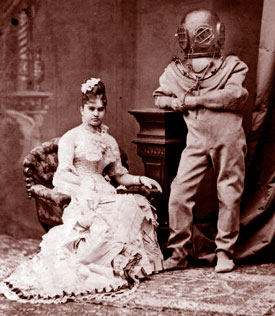 Reginald Tweedsmuire had invented the tongue depressor, tongue scraper and uvula tickler (better known as the Roman Weight Management Apparatus), and he was said to be in line for a Knighthood for his Force 10 Mustache Wax (capable of keeping even the most impressive mustachios stiff and manly in high winds, and much-beloved by Prince Albert). As such, the family was actually quite wealthy, and able to afford the best finishing schools for their only daughter.
 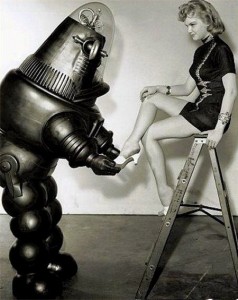 Despite his bulbous legs and intimidating appearance, customers liked Robby’s warmth and genuine desire to make them happy. (He was programmed that way, but still.)
 The Phrase Freak heartily supports the efforts of Lake Superior State University to find those words that are most obnoxious, most odious, and clearly damaging to the glory that is the English language. However, this year’s list is a little weak.