 |
Emily's Biography | The Oeuvre | Flannigan Bio | The Inventions |  |
| Associated Figures | Literary Contest | The Frolics Store | About the Circle |
|
|||||||||||
| Michael Flannigan - a life of invention | ||||||||||||||||

|
||||||||||||||||
|
Michael Flannigan: Chapter 1: Born in the Age of Invention (1783-1799) Chapter 2: How Thick Was Trevithick? (1799-1803) Chapter 3: Flannigan at Trafalgar (1803-1805) Chapter 4: Flannigan and the War of 1812 (1805-1819) Chapter 5: The Infamous Seal Penis Incident (1819-1821) Chapter 6: The Vibraphonic Bellows Era (1821-1829) Chapter 7: Zanzibar's Freak Festival (1829-1833) Chapter 8: The Manx Minx (1833-1836) Chapter 9: Sloe Gin, Head Hurly and the Bull Ring Riots (1836-1840) |
Chapter 4
Having thrown himself over Victory's stern rail with the express purpose of falsifying Whipple's death, Flannigan bobbed among the British flotilla, attempting to avoid the dubious dichotomy of being run down or rescued. Fortunately, none of the warships came close enough for the former, and the latter was avoided when a half-blind lookout named Lester Plugg mistook Flannigan for either flotsam - or, quite possibly, jetsam - but certainly not a British sailor clinging pluckily to a slowly-deflating Bosun's Bar. After three days at sea, Flannigan
and his now rather limp canvas tube washed up south of Cadiz, the principal
seaport of Andalusia, in southwestern Spain. Somewhat stuporous from
the cumulative effects of sun, salt-water, starvation and severe thirst,
and anxious to leave Spain as quickly as possible (1),
the sodden Flannigan set off to walk to British Gibraltar.
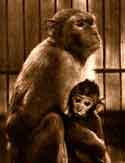
Few records exist of Flannigan's sojourn in Gibraltar, a notable exception being a letter sent to his friend, the educator Impetigo Trundle (2), in which Flannigan writes: "I have stopped in Gibraltar, where there are no women, little water and many British troops. I am surrounded by arse-scratching monkeys. There are also baboons here."
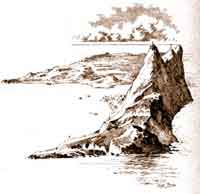
Unsurprisingly, Flannigan was eager to move on once he had made a full recovery from the trauma of his nautical misadventures. After months of deprivation aboard ship, he was more than ready to resume his travels, pursue a new career, meet eligible (and willing) ladies and eat food that would challenge his palate rather than his digestive tract. A chance meeting with the newly arrived British soldier Desmond "Curry" Riffles (3) at the summit of the Rock of Gibraltar was destined to provide Michael Flannigan with all that. and more. Finding themselves both gazing wistfully at the same ape's blue behind, Flannigan and Riffles started to converse, and found much in common. Riffles, a noted raconteur, gourmand, oenophile and old India hand (4), invited Flannigan back to his billet for a "jolly big snifter of rhino piss" and a "ruddy great buffet of Indian whatsits, whipped up by my batman. he's from Jammu (5), makes a tiddly goat vindaloo." Seven days later, wracked by intestinal pain (6) and issuing severe threats against the life of the emaciated gnome-boy named Nehal who had promised "this Indian vegetarian dish that you are really going to love," Flannigan found himself being loaded onto Rattlesnake, an American corvette captained by John Bastard and headed for Boston, medical treatment and love.
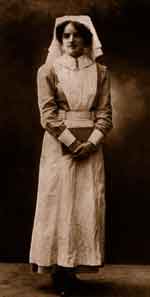
The midwinter trans-Atlantic voyage was difficult for Flannigan. He had vowed in his letter to Trundle that he would "sooner have [his] bowels extracted through [his] nasal passages than go to sea again." Given Flannigan's gastro-intestinal distress coupled with a rather rough crossing, the journey was equally unpleasant for Captain Bastard and his crew; unlike Flannigan, who could only see in the direction he was vomiting, they were able to observe the contents of their deathly ill passenger's innards emerging from all his bodily portholes on a daily basis before they hove to in Boston harbour. Captain Bastard quickly divested himself of the now filthy, reeking and despondent Irishman, giving him over to the nuns who ran the "Our Lady of Perpetual Guilt" Hospital in Hardwick, Massachusetts near the Quabbin Reservoir (7). There, in a ward reserved for madmen, tropical diseases, wounded lovers and foul-smelling bog-trotters, Flannigan - half-crazed and feverishly giving his name once again as "Whipple" - met the young nurse and single mother, Lydia Klamm, who would both nurse his fragile body and nourish his flagellated soul. Under Nurse Klamm's careful supervision, Flannigan regained both his tastebuds and his zest for life (not to mention his manly appetite). After a few solid meals and a damned good go with a bar of lye soap and a stiff boot-brush, the patient was released from the hospital and, having nowhere else to go, was offered short-term accommodation on the kind and shapely nurse's living-room sofa. Taking this as a subtle invitation, Flannigan waited until the dead of night, mounted the stairs, opened the bedroom door, quietly lifted the bedcovers. . and came face to face with the luscious Lydia's two year-old son, Squire, who bit him on the nose.
Never one to give up easily, Michael Flannigan persevered. Night after night, he mounted the stairs, and night after night, young Squire bit him. Night. bite. Night. bite. Again and again and again. until one night when Flannigan nose found itself being bitten by the fair Lydia's teeth, and the rest of him found itself mounting much more than the staircase. This situation quickly became more serious, and Flannigan's "naughty nights with nurse" turned into days, then weeks, and eventually months. During this period, Flannigan found himself spending a great deal of time with Lydia's son. Squire Klamm was a technically a bastard, having been born out of wedlock. He was also literally a Bastard, the itinerant and randy Captain of the Rattlesnake being his biological father. Flannigan soon decided to put an end to this confusion. On September 16, 1807 - the boy's third birthday - young Squire's "Uncle" Michael and his mother Lydia tied the marital slip-knot, and the young ring-bearer was renamed "Squire Whipple." (8) This period of marital and family bliss continued for three years, until Flannigan, coming home late one evening, mounted the stairs, opened the bedroom door, quietly lifted the bedcovers. . and came face to face with that bastard Bastard, who bit him on the nose. Flannigan took the hint, and the good suitcase. Swearing off women "for good this time," he headed south to Washington, DC in search of his friend Henry Clay, the influential Kentucky congressman. Flannigan and Clay had met in hospital after the Southerner was wounded in a duel over a woman's honour, and he knew that his friend would offer him emotional support, somewhere to sleep, and unlimited access to his liquor cabinet. He also hoped to be offered a job, although his experience was somewhat thin, being limited to world travel and inventing peculiar devices that often proved dangerous. Thus did Michael Flannigan become the U.S. government's most senior foreign policy expert, advisor on military tactics and public relations specialist. Glad of a paycheque, and still annoyed at England for the Royal Navy's brutish treatment of its seamen, Flannigan turned his prodigious talents to helping Clay's expansionist colleagues in Congress achieve their territorial ambitions in the West and Florida (9). Harnessing the nationalistic fervour and anti-British sentiment of these "Warhawks" proved easy, and soon Flannigan's employers were actively agitating for war. Thanks both to Flannigan's persuasive abilities and England's predatory actions at sea,
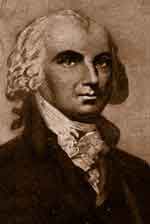
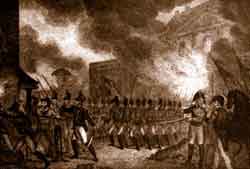
President Madison was soon convinced that the British were bent on permanent suppression of American commerce. The President engaged Flannigan as a speechwriter, and immediately proclaimed "non-intercourse" with England. He further stated that this action would "necessarily lead to war" unless England stopped its impressment of American seamen and seizure of American goods and vessels. The President also followed Flannigan's advice and took armed possession of West Florida, although he didn't tell anyone else. Once again, Flannigan was at the epicentre of war. The thrusts and parries of the War of 1812 were many, and there were victories, defeats, decapitations and disasters on both sides. The British, the French, the Indians, the Americans. all fought, bled, died and rejoiced, although not necessarily at the same time. Although the British clearly won the war, thanks largely to the stupidity of their generals and the bravery of those defending Upper Canada, Flannigan's well-crafted speeches swayed public opinion, and the gullible Americans were easily convinced that they were the victors (10). Flannigan's greatest triumph as a public relations flack came in 1814. Despite the ignominy of the President and his wife having to flee in the face of advancing British troops bent on laying waste Washington, DC, including setting afire the executive mansion, the Capitol, and other public buildings, the headlines were unrelentingly positive: "War a Flaming Success". "White House Renovation and Upgrades Planned". "President Madison is Hot Stuff".
Although Flannigan's career in politics was a resounding success, it came to a rapid end. On the eve of traveling with Henry Clay to the signing of the hostility-ending Treaty of Ghent, Flannigan fell off his self-imposed celibacy wagon, and ended up on an aphrodisiac bender that went on for four years. Little is known of those years, although scholars believe that this is the period that inspired Flannigan to write the Western world's first "self-help" book (11), The Seven Habits of Highly Effective Rabbits. A legal battle over copyright prohibits the publication of all but the following short excerpt from the book: Flannigan's Seven Habits
On New Year's Eve 1819, Michael Flannigan emerged from his self-imposed - but hardly solitary - exile, and climbed once again upon the world stage. --"Scholarship" by The Flyboy
Next: The Infamous Seal Penis Incident
1) Cadiz was unlikely to be overly welcoming, having been both blockaded and bombarded by the British in recent years. [back] 2) Headmaster and Interim Plenipotentiary of the Bagshot Corrective School for Boys with Evil Tendencies and Unnatural Desires. [back] 3) Known in military circles as "Silent But Deadly." Suspected to have been a British Army sanctioned assassin, and rumoured to have brought about the untimely death of Charles Cornwallis, Governor-General of India in October 1805. [back] 4) As the Journal of Courteous and Gentlemanly Execution put it in its profile of Riffles in the Spring 1804 issue, "He puts the 'Chap' in Chapati." [back] 5) Near the verdant valley of Bagrot, in India's Kashmir region. [back] 6) This painful and embarrassing episode may have been the catalyst for Flannigan's Fecal Banishment Apparatus. [back] 7) Where, in a small dinghy, Bastard "learned the ropes" of both sailing and sex. [back] 8) The relationship between Flannigan and his newly-legitimate "son" provides scholars with another opportunity to argue the issue of "nature vs. nurture"; young Squire - despite none of Flannigan's genes - became a civil engineer, and was the inventor and theoretician who provided the first scientifically based rules for bridge construction. Sadly, without Flannigan's freakishly long-lived genes, Squire Whipple did not live as long as his "father," dying in 1888 in Albany. [back] 9) Always a visionary, Flannigan saw that the mild climates of California and Florida would make each a pleasant holiday spot. A subsequent letter to Impetigo Trundle makes brief mention of Flannigan's never-realized idea for a series of parks revolving around the theme of Great Inventions, possibly to be named "Flannigan World" or perhaps "Flannigan Land." [back] 10) A national condition that persists to this day. [back] 11) The Kama Sutra is more likely the real first self-help book, although many erroneously consider Samuel Smiles' book Self-Help (London: John Murray, 1882) to be the first such tome. [back]
|
|||||||||||||||
| Emily's
Bio | The
Oeuvre | Flannigan
Bio | Inventions
Join our mailing list or send us email. All written material, graphics, logo, and html coding Web Monkey: Mark A. Rayner
|
|
|||||||||||||||
![ecrc logo [link to homepage]](../../images/logo_duo_med.jpg)