Ask General Kang: Is it okay to have a family of rodents living in your beard?

Ask General KangAh, I get this question all the time.

The answer is an emphatic no.

The rule is: vermin are permitted, but they have to be smaller than your pinkie fingernail (and non-toxic).

In social situations, rodents (mice, rats and voles especially) can be quite off-putting, if only because they eat the tasty creatures that can make for a nice grooming session.

Quite often I’ll get together with General Coco and Major Bonzo, and our respective spouses; once Major Bonzo had a swarm of killer bees hiding in his goatee, and this was a real damper on the evening. (He was a colonel before this incident.)

Next week: My spouse has mutated into a 12-foot Gila monster. How should I introduce him at social occasions?

Humor-blogs.com is rife with gila monsters. Alltop has a iguana problem.

Passive-Aggressive Punctuation

Designer Ze Frank has a creative way of dealing with those annoying client emails that he has to answer politely, and dare we say, with a certain amount of unctuousness. The customer is always right, but this kind of constant kowtowing can cause anger to build up, and eventually, something bad will happen. You know, an event that involves sniper rifles and bell-towers, or epic schnapps benders that end with you found dead and naked (not necessarily in that order) somewhere in Tijuana. Or, it might just develop into an internal time bomb YouTube Preview Image.

But wait, Ze has found a way to write those cringing, polite emails without a Vesuvius of Rage building inside your brain. Just mentally replace the punctuation with your own set of phrases that will make you feel like you’re saying what you really mean. Click on the image or here to go see Ze’s (older but still funny) presentation:

Passive-Aggressive Punctuation

Everyone always says what they mean at humor-blogs.com and alltop too.

Professor Quippy: Scoring Pizza & Bad Stomach Chemicals

Professor QuippyResearchers have discovered that you can blame your pudgy middle on bad chemicals.

According to researchers at McGill University in Montreal, Canada, a hormone secreted by the stomach can cause junkie-like behavior when you see food.

Pizza? Score! Chicken wings? Groovy! Chocolate cake? Drop that man!

The guilty culprit is not your lack of willpower, it’s the hormone ghrelin, which is made in your stomach. As you get hungry, ghrelin levels rise and when you’ve eaten, they wane. In the study, volunteers were given a shot of ghrelin and then shown pictures of scrumptious, irresistible food. Their brains lit up just like a junkie’s.

Alain Dagher, a neurologist at McGill, says this is probably an evolutionary mechanism that encouraged our distant ancestors to bulk up on tasty calories whenever they had a chance (which probably wasn’t very often.) Fast forward a few thousand years, to the Era of Addictive Chicken, and this spells an obesity epidemic.

According to the New Scientist: “Several pharmaceutical companies already have their sights set on ghrelin, as drugs that block the hormone may quell hunger and fight obesity.”

The problem? If you turn off the hormone, it may affect other parts of your brain. Like, the segment of your cerebellum that makes you happy. The part that prevents you from falling into a deep, sponge-cake-like depression. And then killing yourself.

So, a danger of suicide, but at least you wouldn’t be fat anymore.

Humor-blogs.com is hopped up on laughter. Alltop too.

SITI — Search for Intelligence on Teh Internet

Alien named LarryIn an attempt to help understand why there is so much absolute dreck on the web, I suggest that we establish SITI — the Search for Intelligence on Teh Internet, roughly based on the model of SETI (Search for Extraterrestrial Intelligence).

This is a project that is long overdue, and with any luck, we will have more luck finding intelligence than SETI.

The SETI movement was energized in the 1960s by Dr. Frank Drake, when he came up with an equation to estimate the number of extraterrestrial civilizations in our galaxy. Now, I’d like to (modestly) propose we use his equation to estimate the number of intelligent website we may be able to find on the net.

The Drake “equation” states that:
the drake equation
n= the total number of intelligent sites out there
R* is the rate of website formation on the Internet
fp is the fraction of those websites that have weblogs
ne is average number of weblogs which can potentially support coherent thought
fl is the fraction of the above which actually go on to demonstrate coherent thought
fi is the fraction of the above which actually go on to show a sense of humor as well
fc is the fraction of the above which are willing and able to communicate
L is the expected lifetime of such an intelligent website.

Yes, some may argue that looking for coherent thought on a weblog is misguided, but I believe it’s our best shot.

Prove me wrong.

No doubt some boffins will now take this flash of brilliance, and give us a script to help us figure it out in real time. However, let me give you my best guess:

6 million new websites each year
X .5 (% with weblogs)
X .5 (% capable of supporting coherent thought)
X .001 (% demonstrating coherent thought)
X .001 (% showing a sense of humor)
X .6 (willing and able to communicate)
X 3 (lifetime of website, in months)
= 2.7

Hmm. Well, if I assume The Skwib is one of the 2.7, then who are the other 1.7? My guess is that they’ll be found on humor-blogs.com or perhaps alltop. Hey, you can’t argue with this, this is science!

Obligatory link to Wikipedia article on the Drake Equation, if you’d like to know what those things really stand for. Thanks to Garette for the toothy alien.

The Lost PowerPoint Slides (Prehistory 1.2: Thag Do Invention)

The Lost PowerPoint SlidesHuman societies existed long before the written word, but luckily for us, not before PowerPoint technology. This makes it much easier for anthropologists, historians and people who enjoy humor to understand how humans developed as a species — from a sort of limited ape with no concept of how to style facial hair or take to the high seas and become a pirate, to the fully bearded, eye-patch wearing civilization we are all familiar with today.

Continued from Prehistory 1.1…

But being eaten was not the only worry. It was the major worry (apart from starving to
death), but eventually the weather started to get a bit cooler, and early humans started to think about
other things …

Shrinkage solutions

At this point, Homo erectus had finally achieved their goal of a much less amusing species name, and they became two different species, Homo neanderthalensis (or Neanderthals) and Homo sapiens.

The Neanderthals immediately started to improve on Ahk-ahk’s early “thing” technology, coming up with all kinds of intriguing designs, including a tool that “slices, dices and makes julienne mammoth!” Though the Neanderthals have been characterized as squat, hairy and unsophisticated, they greatly improved tool technology with what paleontologists now call the Mousterian Tradition. How such squat and hairy humans came up with the unsophisticated idea of using mice in the
creation of stone tools, we may never know; those paleontologists are a secretive group.

The Neanderthals were out-competed by Homo sapiens, and though their final fate remains a mystery, it appears as though they disappeared about 30,000-25,000 years ago. It has been suggested that Neanderthals did breed with Homo sapiens, the proof of which is the existence of otherwise modern humans with uni-brows.

Him Sexy Caveman!

While the unfortunate and soon-to-be extinct Neanderthals were happy with their mousedriven stone technology, modern humans continued to tinker with things, coming up with greater and more creative inventions. They made fine blades, harpoons, fish hooks, needles, and even created oil lamps. Paleontologists believe modern humans were forced to improve their technology because of the increasingly severe Ice Age. This is only partially true. Certainly, it was getting much colder, but much of the technological innovation was driven by a lack of beard-grooming implements.

Humans also started to create art at this time:

Cave art rocks

This flourishing of culture had unfortunate consequences too, leading the new species to experiment with drugs, find religion and start objectifying women, sometimes all in one go:


Must worship all mother!

Next: The New Rock Age: Your Era at Work!

Also posted at humor-blogs.com and alltop.

The Lost PowerPoint Slides (Prehistory 1.1: Thag Do Invention)

The Lost PowerPoint SlidesHuman societies existed long before the written word, but luckily for us, not before PowerPoint technology. This makes it much easier for anthropologists, historians and people who enjoy humor to understand how humans developed as a species — from a sort of limited ape with no concept of how to style facial hair or take to the high seas and become a pirate, to the fully bearded, eye-patch wearing civilization we are all familiar with today.

Roughly speaking, human prehistory is divided into three ages: The Stone Age, The Bronze Age, and The Iron Age (although amongst golfers this is known as The Difficult Short Game Age).

1. The Stone Age — Thag Do Invention!

The Paleolithic

In a similar fashion, The Stone Age is usually subdivided into three eras — the Paleolithic, the Esoteric and the Neolithic. Some paleontologists call the Esoteric the Mesolithic, or Middle Stone Age; like all middle children it is usually overlooked, but it was nevertheless the period after the Paleolithic and before the Neolithic.

The Paleolithic Age, or literally Old Age of the Stone, is the period we usually now associate with Disco, but actually predates the Seventies by up to a million years. (Though hairy chests were fashionable in both eras.)

In the Paleolithic, early humans were hominids we now call Homo erectus, and had few tools (apart from PowerPoint). In addition to inventing tools, these primitive ancestors worked hard to evolve into the species we are today, not only because their lives were unpleasant, dangerous, and filled with nasty smells, but also because they couldn’t stand it when other animals made fun of their name.

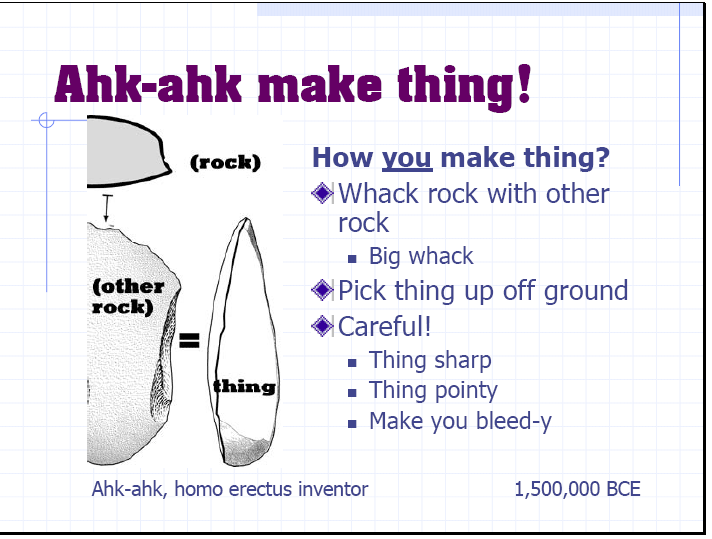
The first major achievement of Homo erectus (stop that) was stone tools. At first, the tools they used were really no more than rocks they found lying around the mosh pit (few paleontologists are willing to admit that Homo erectus were committed slam dancers), but soon they discovered that rock could be shaped.
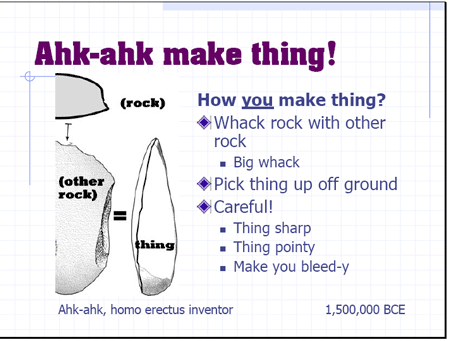
Ahk-Ahk make thing!

Homo erectus continued in this upright fashion for some time, slowly improving their “whacking” technique until they could fashion all kinds of tools — stone axes, knives and eventually arrow points. They became proficient hunters, but even with sharp “things” they found eating raw meat a major challenge to their erectness. (It’s tough to stand up straight when you’re experiencing abdominal cramping.)

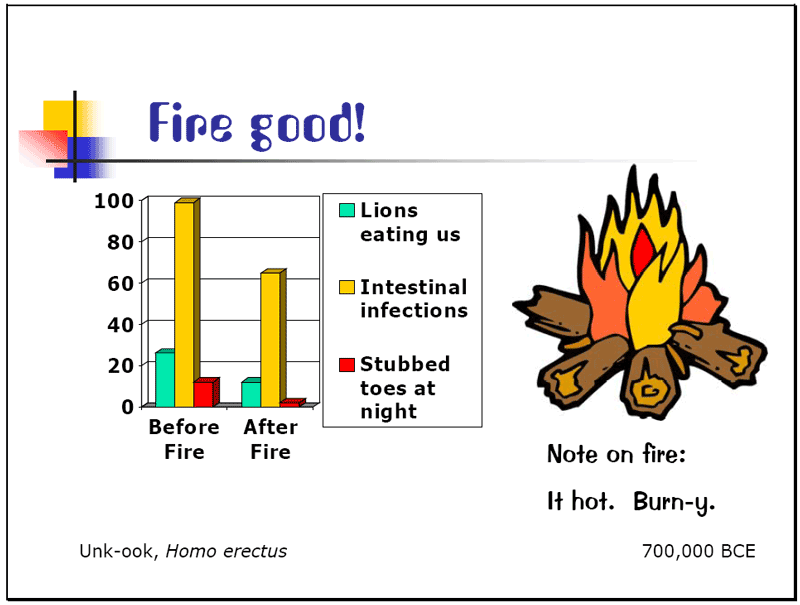
Luckily, the precocious great-great-great-great-great-great-(imagine 22850 more “greats” in this phrase) grandson of Ahk-ahk, Unk-ook, made a major discovery:
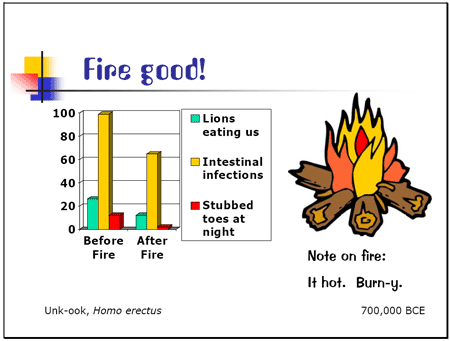
Unk-ook:  Fire good!

Yes, being eaten by lions and other predators was a constant problem in early human society, and
so, a method for dealing with the challenge was implemented, and it had some side benefits:
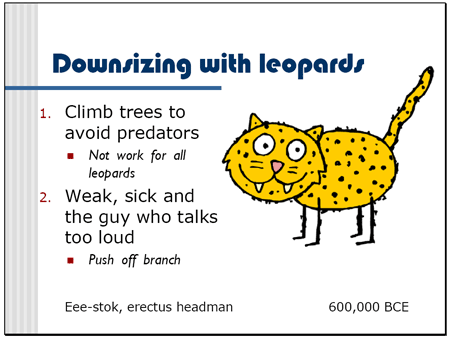
Downsizing with leopards

Next: Clothes, Art & The Advent of the Uni-Brow

Also appearing at humor-blogs.com and alltop.