|
Peruse her biography:
(1856-1880)
(1880-1904)
(1904-1919)
(1919-1948)
The Big Finish
Part I: Fün Untersee
Part
II: Mind-Bombing Berlin
Part
III: Dung Beatles in the Eagle's Nest
Part
IV: Suisse to
Spidgy:
Part V:
The Firey End
|
The Big Finish
Part IV: Suisse
to Spidgy
Emily settled in Zurich.
She used much of the gold she had stolen from the Nazis to set up a schooling
program for children in the refugee camps throughout Switzerland. Otherwise
she lived modestly, taking a small flat on Banhoffstrasse. She could not
find a rowboat to purchase, so for her daily exercise, she took to pole-vaulting.
Thought it seemed like an unlikely thing to the Swiss pole-vaulting team
with whom she practiced, Emily wrote in her journal: "I love the squiffy
feeling you get right at the top."
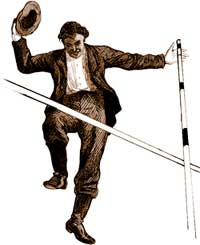 |
| Emily's afternoons were devotd to pole-vaulting;
the Swiss team, with whom she practiced, were impressed not only that
an older woman could pole vault at all, but that she could do so in
a wool suit and a hat. |
As she had done
in happier times, Emily wrote in the mornings, and ate sausages for
lunch. Her afternoons were devoted to "the pole" as she called it. She
made excellent progress on her memoir, and on a number of anti-Nazi
diatribes that she collected into a book called: "The Stench of the
Master Race," which she did not try to publish. She also penned a quasi-autobiographical
novel, "Bugger All That."
It was a lonely period for Emily. With the world at war, the population
of soldiers was bigger than ever, but it did her no good in Switzerland.
Four long years passed as she pined for her younger days and of course,
her frolics trunk. By the end of the war, she had all-but-finished her
memoir, and written another novel, which she hoped to publish in England.
At the end of the hostilities, Emily launched herself from Switzerland
like a V-2 rocket.
Making a stop at St. Pol-sur-Mer to pick up her frolics trunk, Emily
made her way to London to sell her newest novel. Stylistically, the
work was a real departure for her, and she thought it had great allegorical
merit. Her newest speculative work was pure fantasy: It was about an
evil lord and his minions of rank sub-human creatures called "orcs".
The lord (Nauros) needed to find a magical ring for his victory over
the "elves", "humans" and "dwarves" to be complete. Luckily for them,
a hairy-footed character named Drofo, a "hobbit" was able to destroy
the ring.
Publishers said the work was too eccentric to be successful. In particular,
they were scathing in their criticism of the title: "Smelly Old Buffers
in Fantastical Realms."
Her old friend J.R.R. Tolkien, with whom she was staying, loved the
story. (Though he was a bit miffed that she'd ripped off the idea of
hobbits.) His praise did much to cheer Emily up, and she records in
her journal: "I told him that he could keep the manuscript. I had no
further use for it, if it wasn't going to get published."(1)
Tolkien, in turn, invited Emily to stay on in Oxford with his family,
as he'd just been made Merton Professor of English Language and Literature.
But Emily demurred, and found herself a cozy and affordable bed-sit
in the London suburb of Spidgy Park.
Next:
Part V: The Firey End
...>
Notes:
(1) Tolkien's "The Lord of the Rings" was published
in 1954. [back]
|