|
Emily's Biography | The Oeuvre | Flannigan Bio | The Inventions |  |
| Associated Figures | Literary Contest | The Frolics Store | About the Circle |
|
|||||||||||
| Emily Chesley - a biography | |||||||
|
|
|||||||
|
Peruse her biography:Formation (1856-1880)London, Ontario (1880-1904) Travels (1904-1919) A Long Twilight (1919-1948) ...Chesleyan Timeline ...The Oeuvre The Big Finish Part I: Fün Untersee
|
The Big Finish
Emily settled into a comfortable, if sausage-scarce, routine in Spidgy Park. She had come to an uneasy truce with Great Britain. The British had left Ireland, and she appreciated what they'd done to defeat Germany. Though occasionally her old rancor would surface: "The only good thing I can say for the Nazis is that they did me the favour of finally destroying the dung heap. On the whole, I believe the English are a much more palatable without an empire." (Speculations) In 1947, India gained its independence from Britain. Chesley sent a congratulatory note to Gandhi, whom she remembered well from South Africa: "Good job kicking them out your country, Mohatma. Sorry I never got back to India to see if your technique had improved. Who knows though? Keep stretching!" (1) She continued to
write, more out of habit than inspiration. Her last two books are filled
with questions of family; she wondered if she would ever understand
the nature of her heredity, or how she had never, in all her "encounters"
conceived a child.(2) The old
gravedigger in Dingle had clearly been trying to say that her "uncle",
Michael Flannigan, was no true relation at all. But that did not ring
true. So in early April, 1948, she went into London to hire a genealogist
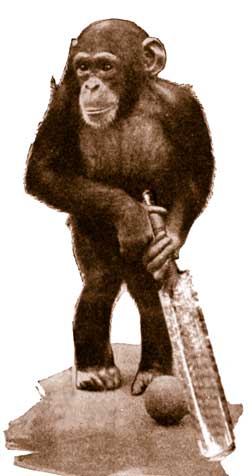
to do some further research. On the return train, she ran into Hilda Matheson, the renowned lesbian and one-time secretary to Lady Nancy Astor. Matheson had mellowed in her old age, and chatted amiably with Emily. It seemed that Matheson had developed a grand passion for cricket, and she was heading to the opening match of a new Ashes series between Australia and England later that month. She invited Emily to join her. Emily agreed to go, even if, Emily as confided in her journal: "the old dyke just likes to see me in a suit." But soon she and "Hildy" (as Emily called Hilda), were traipsed around England, watching the Australian team cut a swath through all of English cricket-dom. (3) At the first match,
Hildy volunteered to explain the rules to Emily. She recorded her answer
in her journal: "I've gone through life completely baffled by the rules
of cricket and I am happy to muddle through the rest of my allotted
time in a similar haze." Indeed, Emily was shocked to discover that
cricket was such a popular sport, even played in Norway. In her journal
she remarked: "I find it hard to believe that a sensible people such
as the Norwegians would even play cricket."
But for all her criticisms, there was something relaxing, meditative, even spiritual about the game. Matheson was mad for it. For her own part, Emily simply enjoyed "watching a bunch of fellows make complete arses of themselves." Emily also liked making fun of the unlucky bastards playing ""silly mid-off" and "silly mid-on". The purpose of all this mid-on and -offing was to win the coveted Ashes.(4) During one game, Emily idly suggested to Hildy, that, "wouldn't it be fun if they all worked so hard to win me? Ah, but those days are over." After the series was done, Emily and Hildy were fast friends, and would often meet for lunch in London (sausage availability was much improved by 1948). It was in the fall that Emily finally heard back from the genealogists whom she had engaged to learn more of her ancestry. Her reaction is recorded in her journal, the last words she ever wrote:I am gob-smacked. It seems as though the old gravedigger was both wrong and right. I am related, by blood, to Michael Flannigan, and through my mother as I suspected. But it seems as though . . . oh, this is just too difficult to believe, but I hold the patent application and Uncle's notes in my hand. Could he have been so far ahead of his time that it was possible for him to actually . . . but wait. Is that the sound of sirens? Scholars will never be sure what Emily was going to write next, or indeed, what the patent application and notes described, for they were consumed in the same fire that ended her life. The rest of the story is documented by the Spidgy Shopper (afternoon edition), October 29, 1948:
For a woman of such grand passions, it seemed fitting that she should meet her untimely end in a fire. There was no obituary for her and Chesley was unmourned by anyone except for Hildy Matheson, who collected a handful of ashes and placed them inside the famous cricket trophy on her next pilgrimage to Lords. The End
Return to the biography section...>
Notes: (1) This reunion was never to be. Gandhi was assassinated in early 1948. [back] (2) This topic is discussed in Dr. Maximillian Tundra's unfinished 1998 medico-literary tract: Ovary Ovation: Auto-Didactic Generation in Emily Chesley. [back] (3) Later known as "The Invincibles" the Aussies won every match and broke a number of records, including being the side to score more than 400 to win a Test match. Whatever it means, it's a feat only matched once since then.[back] (4) The first time the English lost to the Australians, a mock obituary ran in the Sporting Times: "in affectionate remembrance of English cricket. The body will be cremated and the ashes taken to Australia." The next English team to tour Australia was presented an urn containing the ashes of a bail.[back]
|
||||||
|
Join our mailing list or send us email. All written material, graphics, logo, and html coding Web Monkey: Mark A. Rayner
|
 |
||||||