Archive | The Lost PowerPoints

The Lost PowerPoint Slides: A Short Man Invents a Complex (and Conquers Europe)

The Lost PowerPoint SlidesThe Battle of Waterloo

Napoleon Bonaparte is an iconic character, not only because he was short, wore a silly hat, and had enough pirate brothers to conquer most of Europe, but because he is the only person in history to meet his Waterloo actually at Waterloo. (The rest of us tend to meet it in boardrooms, law courts, amateur beard-growing competitions, and if you’re English, in Surrey.) Had Napoleon won the Battle of Waterloo, civilization would be quite different. For starters, there wouldn’t be 2,050,000 results on Google for the term “French surrender” (there would only be 2,049,999.) Also, we would all eat a lot more snails.

But Napoleon did not win the battle. Later his opponent, the Duke of Wellington (also famed for rendering beef completely inedible and known as “Sally” to his friends), described the fighting as: “The nearest run thing you ever saw in your life,” which was Sally’s way of saying Napoleon almost won. To add insult to injury, Napoleon’s famed Imperial Guard — the closest thing the French Army had to crack assault pirates — ran away:

Bugger

My pirate brothers and sisters include Captain Stanky and Rank Ol’ Pete.

The Lost PowerPoint Slides: Ruff ‘n Ready in Merry Olde England (Part 15)

The Lost PowerPoint SlidesQueen Elizabeth I

In her day, the first Queen Elizabeth (Queen Elizabeth I), was widely regarded as the scariest female to roam the planet since Lucy the Menopausal T-Rex. Of course, her closest advisers and the members of the English court knew that was far from the truth: Elizabeth would have destroyed Lucy.

However, amongst her subjects, she was known as Good Queen Bess; she was known as the Virgin Queen, and much beloved because she really did care about her people. The whole question of virginity was a potential PR nightmare, though in the long run, not as destructive as the lead-based makeup Bess spackled onto her face for public functions.

Good Queen Bess's Lost PowerPoint Slide

The Spanish Armada

In 1588 the King of Spain (Phillip II) finally got fed up with English privateers continually raiding his ships and colonies in the New World. (Note: Privateers were a kind of state-sanctioned pirate. Though they were obligated to give a portion of their booty to the monarch who licensed their pillaging, they still had hooks for hands, parrots for pets, and spent a great deal of time obsessing over “pieces of eight.”)

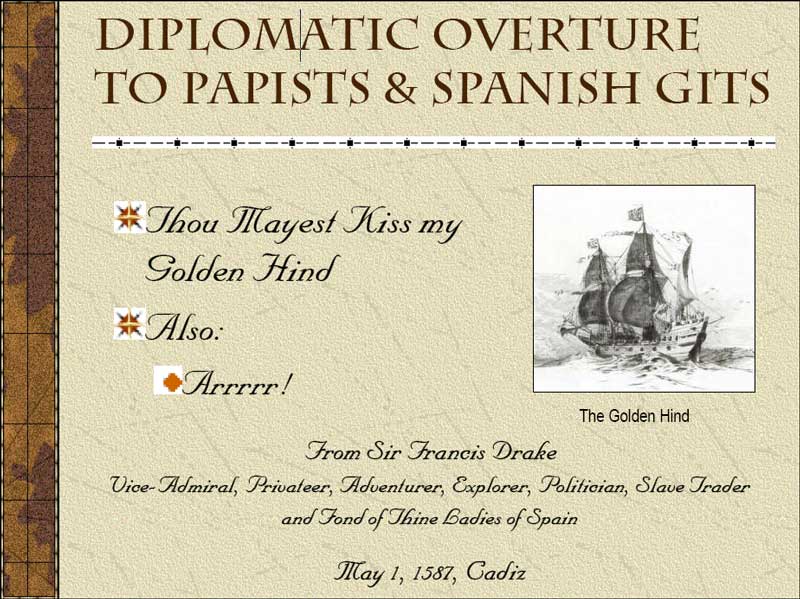
To put an end to English interference, Phillip amassed a ginormous flotilla — the didn’t call it an “Armada” for nothing — to support his invasion of England. The Spanish fleet might have sailed in 1587, had not the English hero, Sir Francis Drake, staged a preemptive raid on Cadiz.

Kiss My Golden Hind

For an armada of humor, set sail for the Isle of Laughter or the Archipelago of Chuckles. More Lost PowerPoint Slides can be found here.

The Lost PowerPoint Slides: Trojans and Triremes– It’s All Greek to Everyone! (Part 6.1)

The Lost PowerPoint SlidesMany historians consider Ancient Greece to be a seminal culture, from which the foundation of Western Civilization sprung. A small group of non-conformists believe that seminal culture is something that should only be used during in vitro fertilization. Humor bloggers just giggle at the mention of the word “seminal”.

In any case, if you were alive in the years from 500 BC to about 146 BC, then Greece was the place to be. You also would have been fabulously old, and probably incapable of enjoying Greece’s many fine pastimes, such as philosophy, drama, hanging with your hoplite buddies, or a variety of activities with olives. (Some of them illegal nowadays.)

This time period is often broken up in to two periods, the Classical, and the Soft-Rock period (also known as the Hellenistic period).

Classical Greece

Prior to this time period, the Greek city-state had developed; these city-states were ruled by kings, tyrants and oligarchies. An oligarchy was a kind of large-headed pirate that owned land, slaves and enormous bronze helmets. The most powerful oligarchy was in Sparta, which was renowned for its powerful warriors, cruel child-rearing practices, and a susceptibility to sore necks. While the Spartans were at the masseuse, the city of Athens developed a new method of ruling, which they called democracy (though only a small number of male citizens were allowed to vote, no matter how big their heads were.)

These city-states existed not only in Greece itself, but in Asia Minor, or what is now the Aegean coast of Turkey. This area was called Ionia, and the Persian Emperor, Darius the Great, thought it would be nice to own, so he did. (According to Darius’ younger brother, Whinius, he always taking things without asking.) When the Ionian Greeks rebelled, the Greek Greeks (in Athens and a few other cities in Greece) supported them. Then Darius thought it would be nice to own Greece too.

Darius wasn’t all bad — he was one of the few ancient rulers to ban slavery, but this didn’t help him invade Greece. The Persians landed their fleet at a place called Marathon, which is about 25 miles from Athens. Knowing the large-headed pirates of Sparta were excellent soldiers, the Athenians sent a runner to ask for their help, a round-trip jog of nearly 300 miles, which the messenger, a long-legged freak of nature named Pheidippides did in three days. We celebrate this magnificent feat of athletics by strapping on running shoes (often named after the Greek Goddess of Victory, Nike), and clogging the streets of Boston during their annual short constitutional run:

the first marathon

Humor-blogs.com and Alltop like to do “things” with olives.

The Lost PowerPoint Slides: The Ultimate Pyramid Scheme (Part 5.1)

The Lost PowerPoint SlidesThe ancient Egyptians were famous for taking the concept of “work” and the mysterious burial chamber to new heights (and depths), when they began building massive edifices they called “pyramids”.

Though initially it was thought these were sophisticated storage receptacles for a variety of mummified sweetmeats, it turns out that they were in fact a form of political propaganda.

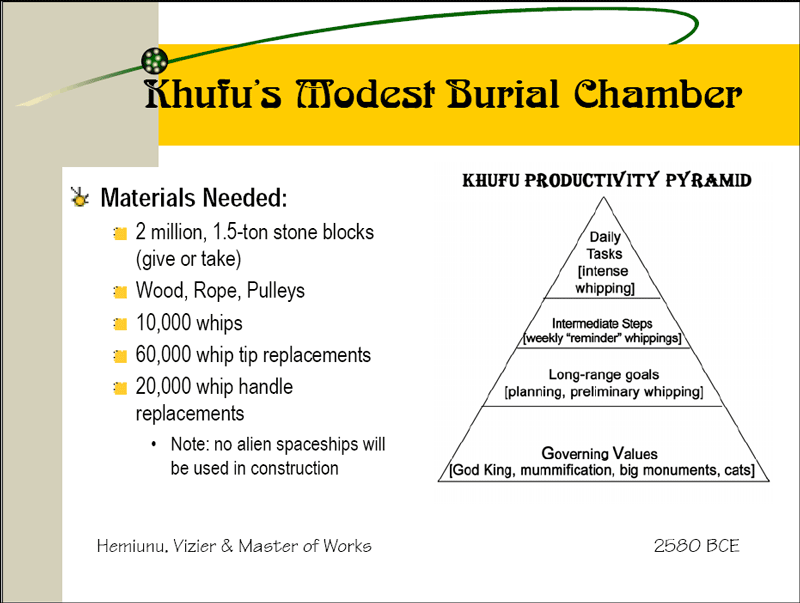
In either case, whether they were constructed to later enable Bud Abbott’s cinematic career, or if they were created to show posterity how seriously kick-ass the Pharohs were, there were certainly side effects. The most serious, at the time, was the pressure it put on the economy responsible for work motivation. Today, this has morphed into something called “human resources”, but back in the Pharoh’s day it was a much less complicated affair, something called Khufu’s Productivity Pyramid:

Khufu's Modest Burial Chamber

These fine websites provide humorous whippings daily.

The Lost PowerPoint Slides: The Neolithic (Part 1.3)

The Lost PowerPoint Slides

Continued from the Paleolithic or Emo Stone Age

.

After the confusion of the Esoteric Age (or Middle Stone Age), things got really strange. The Neolithic (or New Stone Age) is known for the “Neolithic Revolution”, in which humans started to give up their earlier hunter-gatherer lifestyle in exchange for farming. Many experts still think this was a mistake, though it did eventually lead to the Bronze Age and improved beard-grooming implements.

Some researchers are still trying to figure out why human beings would give up the free existence of the hunter-gatherer lifestyle for the unending toil necessary for successful farming, but they’ve obviously never met anyone with a Protestant work ethic and a deep suspicion of the human body’s naughty bits.

Of course, the cultivation of grains could lead to food surpluses, but these benefits were sometimes offset by bad harvests and an increase in disease. Some believe that humans started farming for another, more compelling reason:
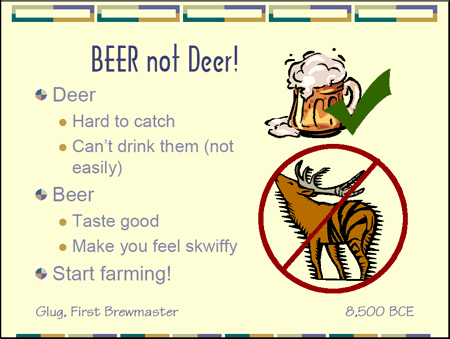
Beer not deer!

Some researchers will refer to this as the “beer theory of history”, but it is really just an antecedent to the Beard Theory of History, which is much more important because it is capitalized (and not in quotation marks). (Grammatically, CAPITALS kick “quotations'” ass, and (brackets) are just kind of embarrassed to be there.) Still, the “beer theory of history” is a compelling idea — the notion that we gave up hunting because of beer. This new sedentary way of life is where our current 21st century obesity “epidemic” began. (And is certainly a contributing factor for the “epidemic” striking the population of humor writers.)

In addition to farming, the Neolithic brought us home renovation. Before the Neolithic “Revolution”, we were happy to live in caves, mossy ditches and an assortment of bark-lined nests. But after the Neolithic “Revolution” we had to start building permanent dwellings, with “features” and “amenities”. Home improvement shows would begin soon thereafter. It was the downside of beer.

We also started domesticating animals. Paleontologists believe we had already domesticated dogs, but it was during the Neolithic Age that humans began to keep animals for more than their companionship and their inspiring ability to lick themselves. Some have suggested that this control over nature led humans to believe they could control other humans. Others have suggested that increasing population densities, specialized occupations and more complex societies called for a ruling class.

In either case, this is called civilization.
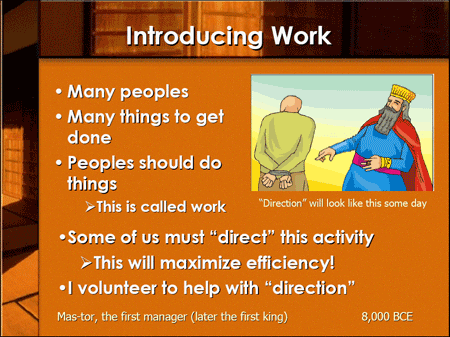
Introducing Work

So one of prehistory’s greatest ironies is that the invention of beer led the majority of humans to be ruled over by a privileged class, making the majority of humans want to drink more beer. (The privileged class preferred wine, even then.)

Despite the advent of agriculture, the domestication of plants and animals, and the first hierarchical societies, humans were capable of behaving even more oddly. At this time, humans also started building elaborate tombs for the dead. Some of these magnificent structures remain today. One of them is the passage tomb at Newgrange, situated in modern-day Ireland. To this day, we have no definitive explanation of what the tomb is for, though we suspect commercial motivations:
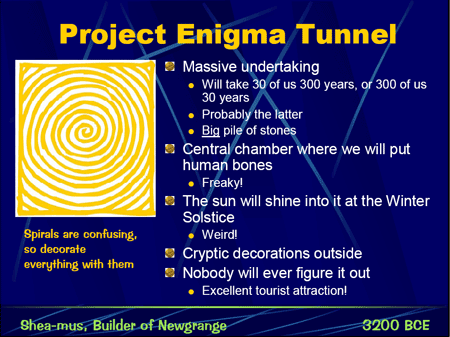
Project Enigma Tunnel

Next: The Ultimate Pyramid Scheme

Humor-blogs.com and Alltop are proof of the Beer Theory of History.

The Lost PowerPoint Slides (Prehistory 1.2: Thag Do Invention)

The Lost PowerPoint SlidesHuman societies existed long before the written word, but luckily for us, not before PowerPoint technology. This makes it much easier for anthropologists, historians and people who enjoy humor to understand how humans developed as a species — from a sort of limited ape with no concept of how to style facial hair or take to the high seas and become a pirate, to the fully bearded, eye-patch wearing civilization we are all familiar with today.

Continued from Prehistory 1.1…

But being eaten was not the only worry. It was the major worry (apart from starving to
death), but eventually the weather started to get a bit cooler, and early humans started to think about
other things …

Shrinkage solutions

At this point, Homo erectus had finally achieved their goal of a much less amusing species name, and they became two different species, Homo neanderthalensis (or Neanderthals) and Homo sapiens.

The Neanderthals immediately started to improve on Ahk-ahk’s early “thing” technology, coming up with all kinds of intriguing designs, including a tool that “slices, dices and makes julienne mammoth!” Though the Neanderthals have been characterized as squat, hairy and unsophisticated, they greatly improved tool technology with what paleontologists now call the Mousterian Tradition. How such squat and hairy humans came up with the unsophisticated idea of using mice in the
creation of stone tools, we may never know; those paleontologists are a secretive group.

The Neanderthals were out-competed by Homo sapiens, and though their final fate remains a mystery, it appears as though they disappeared about 30,000-25,000 years ago. It has been suggested that Neanderthals did breed with Homo sapiens, the proof of which is the existence of otherwise modern humans with uni-brows.

Him Sexy Caveman!

While the unfortunate and soon-to-be extinct Neanderthals were happy with their mousedriven stone technology, modern humans continued to tinker with things, coming up with greater and more creative inventions. They made fine blades, harpoons, fish hooks, needles, and even created oil lamps. Paleontologists believe modern humans were forced to improve their technology because of the increasingly severe Ice Age. This is only partially true. Certainly, it was getting much colder, but much of the technological innovation was driven by a lack of beard-grooming implements.

Humans also started to create art at this time:

Cave art rocks

This flourishing of culture had unfortunate consequences too, leading the new species to experiment with drugs, find religion and start objectifying women, sometimes all in one go:


Must worship all mother!

Next: The New Rock Age: Your Era at Work!

Also posted at humor-blogs.com and alltop.