Archive | The Lost PowerPoints

The Lost PowerPoint Slides (Communist Manifesto Edition)

cover of communist manifestoSpectre haunts Europe (slide 1)

  • Not Engles and his “GIT issues”
  • Communism
  • Unholy alliance against it
  • Overthrow capitalism
  • .

Socialism (slide 3)

  • Abolition of land ownership & inheritance
  • Progressive income tax
  • Universal education
  • Everyone gets a funny hat.

Cool stuff (slide 6)

  • No bourgeois families
    • (Teenagers will probably still be angry)
  • “Community” of women
    • (Free love)
  • Beer for lunch

Inspired by: Publication of Communist Manifesto, Feb. 21, 1848

The Lost PowerPoint Slides (Malthusian Edition)

MalthusMy origins (slide 2)

  • Yes, I am aware of the irony of being born on St. Valentine’s Day.

Population Principle (slide 4)

  • the capacity of the Earth to create food is vastly outstripped by human wubblie potential
  • yes, the ability of humans to reproduce
  • okay, the phrase is sexual procreation, but it’s so embarrassing to say!

Population Principle (slide 5)

In short:

  • wubblie potential is exponential
  • food supply is linear.

Fewer Humans: A good thing (slide 6)

Wubblie potential is only kept in check by:

  • natural causes — accidents and old age
  • misery — war, pestilence and famine
  • moral restraint
  • vice.

Fewer Humans: Vice — further explained (slide 7)

  • infanticide
  • murder
  • contraception
  • Nancy boys.

Preferred methods of reducing Wubblie potential (only slide)

  • late marriage
  • abstinence
  • (no “accidental” touching of jumblies either)
  • yes, I agree, not fun but necessary, and very British!

Inspired by:
Birthday of Thomas Robert “not much for having fun” Malthus, Feb. 1766. NB: There is no historical evidence that Malthus ever used the phrases “wubblies” or “jumblies”.

The Lost PowerPoint Slides (The Dog Edition #2)

Wrinkly dogs in car windowControlling humans (slide 6)

  • staring is effective, but you can’t give up
  • no matter what, keep staring
  • keep with it — don’t take your eyes off them
  • eventually they’ll give you food.

Controlling humans (slide 7)

  • if staring doesn’t work, start drooling
  • copiously.

A Place Called Shangri La (slide 1)

  • this place exists, because I have smelled it
  • doors slide open automatically
  • inside is food, lots and lots of food.

Car etiquette (slide 2)

  • tongue out when under 30 mph.

Car etiquette (slide 6)

  • drive-by barkings are acceptable, and expected.

Property issues (slide 2)

  • if it’s in my mouth, I own it
  • if it’s on the ground, and I can get to it, and put it my mouth, I own it
  • even if I can’t get to it
  • still mine.

Photo by Emdot | More dogs at the Friday Ark

The Lost PowerPoint Slides (DaVinci First ‘Flight’ Edition)

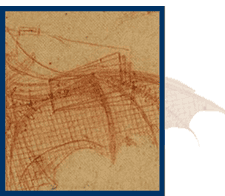
Da Vinci drawing of wingHuman flight (slide one)

  • Always wanted to fly
  • Inspired by bird touching me in crib
  • No, with wing, not guano, wiseass.

Gliding looks likely (slide six)

  • Birds function according to mathematical laws
  • Man can reproduce similar instrument
  • Not eggs, though.

Test behind shop

  • Roof of Corte Vecchia is perfect spot
  • Sheltered corner behind tower
  • Workmen finishing the tiburio of cathedral will not see me and say rude things about the machine.

Twisted ankle (only slide)

  • Glad I only tested from roof, not cliff-top as originally thought
  • Perhaps a parachute next?

Inspired by:
Anniversary of Da Vinci’s unsuccessful flying machine test (January 3, 1496).

The Lost PowerPoint Slides (Phildickian Edition)

Cover art from Valis (1981)Plot points to explore (slide 1)

  1. eroding sense of reality
  2. protagonist discovers that someone close to him is secretly:
    • robot
    • alien
    • supernatural being
    • brainwashed spy
    • hallucination
    • dead
    • from another time.

Plot points to explore (slide 2)

  • a combination of these?

How To Build A Universe That Doesn’t Fall Apart Two Days Later (slide 3)

    we live in a society in which spurious realities are manufactured by:

  • the media
  • governments
  • big corporations
  • religious groups
  • political groups…

How To Build A Universe That Doesn’t Fall Apart Two Days Later (slide 4)

  • what is real?
  • we are bombarded with pseudo-realities manufactured by very sophisticated people using very sophisticated electronic mechanisms:
  • do not distrust their motives
  • distrust their power

Science (slide 1)

  • helps us
  • even with the H-bomb lurking about
  • science has given us more lives than it has taken.

February 20th, 1974 (slide 1)

  • 1 wisdom tooth removal, plus
  • 1 sodium pentothal anesthetic, plus
  • 1 vesica pisces amulet
  • equals multi-verse revealed.

VALIS (slide one)

  • Vast Active Living Intelligence System
  • (gnostic kind of God)

VALIS (slide two)

    Reality:

  • is that which, when you stop believing in it, it doesn’t go away.

VALIS (final slide)

  • Side benefit of this novel — it will totally freak out Mark A. Rayner.

Inspired by:
Hundreds of novels and stories written by Philip K. Dick, born Dec. 16, 1928.

The Lost PowerPoint Slides (Swift Edition)

Jonathan Swift portraitGulliver’s Travels (1726)

  • English establishment = Yahoos

On Religion

  • enough religion to make us hate
  • not enough to make us love one another.

A Modest Proposal (1729)

  • too many poor Irish
  • sell poor babies to rich
  • yes, as food.

On Human Nature

  • Men are content to be laughed at for their wit, but not for their folly.
  • Man is not rational – merely capable of it.

On Government

  • without the Consent of the Governed, Government is the very Definition of Slavery
  • in Fact, Eleven Men well armed, will certainly subdue one single man in his Shirt.

On Law

  • Laws are like cobwebs, which may catch small flies, but let wasps and hornets break through.

On Satire

  • mankind’s virtues –> counted upon a few fingers
  • his follies and vices are innumerable –> time adds hourly to the heap.

“SATIRE is a sort of glass wherein beholders do generally discover everybody’s face but their own; which is the chief reason for that kind reception it meets with in the world, and that so very few are offended with it.”

Inspired by:
Jonathan Swift’s Birthday (Nov. 30, 1667)